
Cube
Cube collects timestamped events and derives metrics, enabling later aggregation such as quantiles and histograms.
About Cube
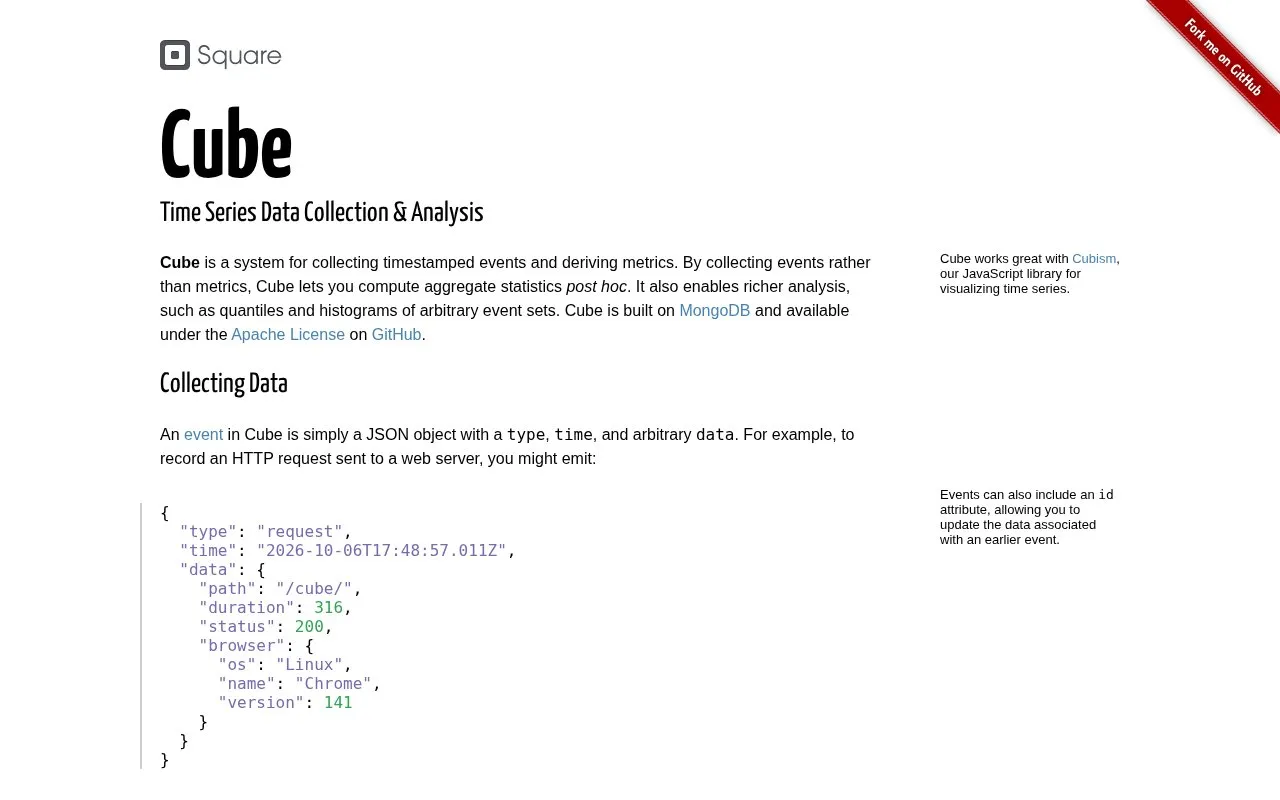
Cube is a system for collecting timestamped events and deriving metrics. Each event is a JSON object with a type, a time, and arbitrary data. Cube's collector receives events over UDP, HTTP POST, or WebSockets and stores them in MongoDB. Because raw events are kept, aggregate statistics such as quantiles and histograms can be computed after collection rather than fixed in advance.
Cube has its own query language for retrieving events and computing metrics, grouped by time and reduced to aggregate values. It caches computed metrics and uses pyramidal aggregation for most metrics, which the homepage says greatly improves performance. The homepage notes that Cube works with Cubism, a JavaScript library for visualizing time series. Pricing is unknown.
Key features
- Collects JSON events with a type, time, and arbitrary data
- Accepts events over UDP, HTTP POST, or WebSockets
- Built-in support for receiving events from collectd
- Query language for filtering events by field values
- Streams events in realtime over WebSockets to multiple listeners
- Computes metrics such as sums, quantiles, and histograms from stored events
Best for: Developers who want to store raw timestamped events and compute metrics from them later, including for dashboards or alerts.
Good for
- Keeping raw events allows aggregate statistics to be computed after collection.
- Cached metrics and pyramidal aggregation can avoid a full event scan for many queries.
Watch out for
- Cube is built on MongoDB, so MongoDB is part of the required setup.
- Pyramidal aggregation is used for most metrics, not all of them.
Cube at a glance
- Website
- square.github.io/cube
- Category
- Development › Developer Tools
- Type
- Website
- Pricing
- Not confirmed. Check the site
- Platforms
- Web
- Open source
- Not stated
- Last checked
- Oct 6, 2026 · Online when checked
- Listed
- Oct 5, 2026
Guides for Developer Tools


Cube alternatives
Tools and sites you could use instead, ranked by how closely they match.

Grafana Cloud unifies metrics, logs, and traces for full-stack observability and AI workloads.
Free
24 alternatives
Lighthouse Metrics runs website performance tests from multiple global locations.

Devhints collects developer cheat sheets covering tools and languages such as Bash, Go, React, Sass, and Vim.

Algebird provides abstract algebra tools for Scala, including components for building aggregations.
Open source
24 alternatives
Python developers can use Zipline’s event-driven library to backtest algorithmic trading strategies.
Open source
24 alternatives
Tonic helps download, manipulate, and load event-based or spike-based datasets for neuromorphic data workflows.
Open source
24 alternativesPopular in Developer Tools
Well-known listings from the same topic.
AppDevToolsappdevtools.comCommand Not Foundcommand-not-found.comTestFlighttestflight.apple.com/join/A8GwCnq8Sourcegraphabout.sourcegraph.comProject Wallaceprojectwallace.comCarbon Calculatorwebsitecarbon.com


Cube FAQ
How can events be sent to Cube?
Events can be sent via UDP, HTTP POST, or WebSockets. Cube also has built-in support for receiving events from collectd.
How are events retrieved?
Cube supports both HTTP GET and WebSockets for retrieving events. WebSockets can be used to stream events in realtime.
Can an earlier event be updated?
Yes. Events can include an id attribute, which allows the data associated with an earlier event to be updated.
Is something wrong or out of date?
Tell us and an editor will check it.
Own this website?
Claim this listing
Claim the listing and suggest updates yourself. An editor checks every claim first.