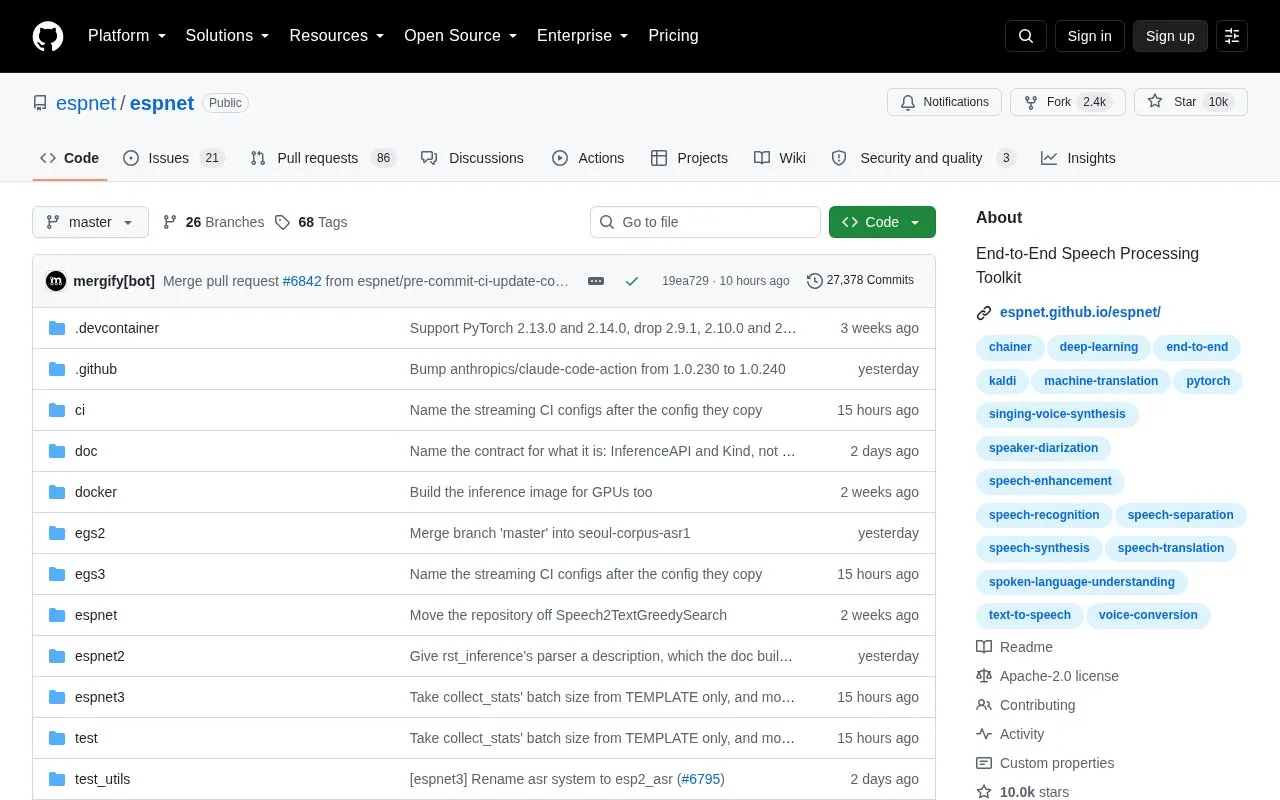
EspNet is an open-source, PyTorch-based toolkit for end-to-end speech processing. It covers speech recognition, text-to-speech, speech translation, speech enhancement, speaker diarization, spoken language understanding, singing voice synthesis, and speech language models, using Kaldi-style reproducible recipes that run from data preparation through evaluation. Pretrained models are published on Hugging Face, and a command-line interface can transcribe, phonemize, align, or synthesize without writing code.
Installing the base package runs pretrained models; training them requires the espnet[train] extra, and PyTorch must be installed separately first. ESPnet1 is no longer supported, and test coverage across operating systems and PyTorch versions is not uniform.
Key features
Command-line inference: espnet transcribe analyzes an audio file and detects language
Tasks include recognition, text-to-speech, translation, enhancement, diarization and language modeling
Kaldi-style reproducible recipes from data preparation through evaluation
Pretrained models published on Hugging Face
Training extras via espnet[train]: Lightning, TensorBoard, W&B, Dask
Docker images for CPU and GPU inference with a published model
Best for: Researchers and developers building or evaluating speech processing systems in PyTorch who want reproducible recipes and pretrained models.
Good for
Open source and covers a broad set of speech tasks in one toolkit
Reproducible Kaldi-style recipes and hundreds of pretrained models
Pretrained-model inference can be run from the command line after a single pip install
Watch out for
ESPnet1 is no longer supported, so older code must move to ESPnet2 or ESPnet3
Training requires the espnet[train] extra rather than the base install
Test coverage is not uniform across the listed systems and PyTorch versions
No. Installing espnet alone lets you run pretrained models; the espnet[train] extra is needed only if you also want to train them.
Which EspNet version should new projects use?
ESPnet1 is no longer supported. The current options are ESPnet2 (egs2/) and ESPnet3 (egs3/).
Which operating systems and PyTorch versions are tested?
Continuous integration covers Ubuntu, Debian 12, Windows and macOS with Python 3.12 or 3.13 and PyTorch 2.11-2.14, though some suites run on only one PyTorch version and pull requests run less than master.
Is something wrong or out of date?
Tell us and an editor will check it.
Own this website?
Claim the listing and suggest updates yourself. An editor checks every claim first.