
Text-to-Audio Generation with Latent Diffusion Models - Speech Research.
Tts Web UI
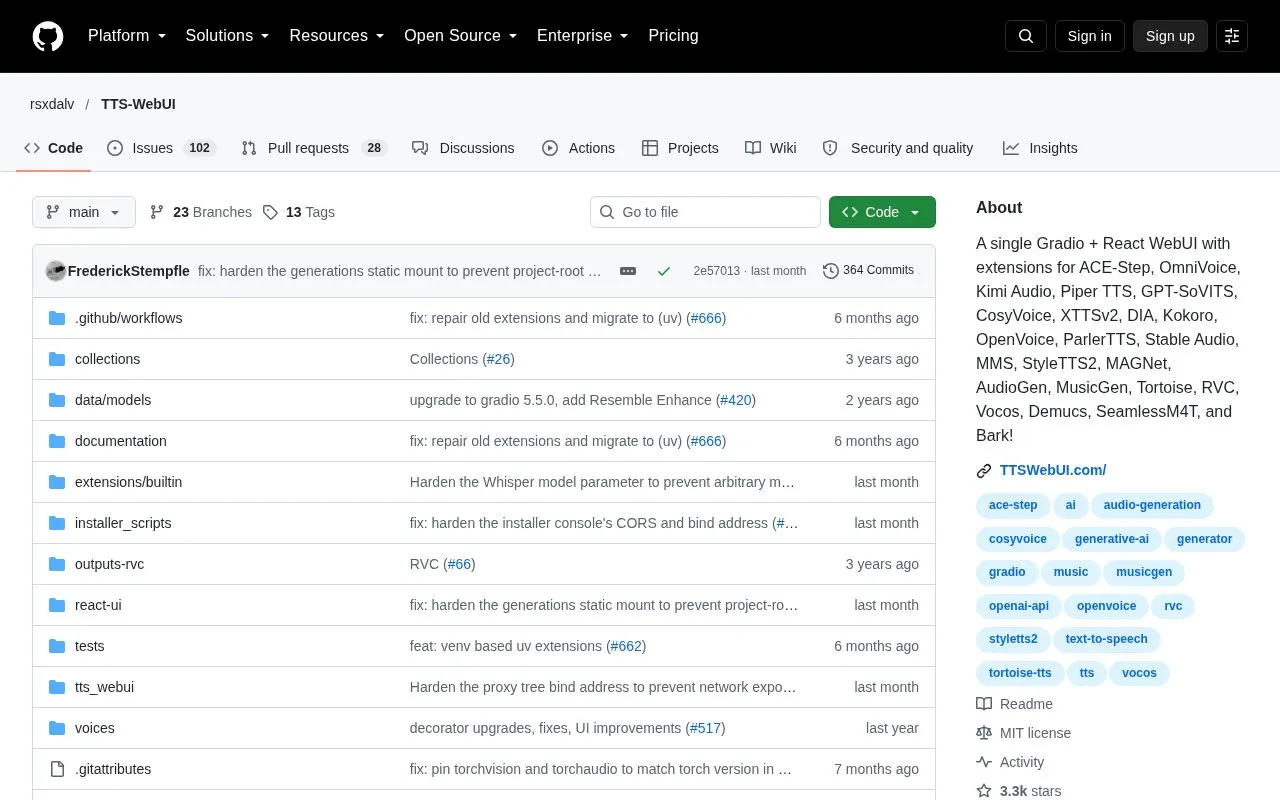
TTS-WebUI is a Gradio and React interface with extensions for speech, audio, and music generation tools.
About Tts Web UI
TTS-WebUI is a web interface that brings several open-source speech, audio, and music generation models into one application. It pairs a Gradio backend with a React front end, and models are added through extensions. By default, the Gradio server runs at localhost:7770 and the React UI runs at localhost:3000.
Installation options include a Windows installer (TTS WebUI Ignition, installed with winget), a legacy installer script, a manual Python setup, and Docker. The base installation is around 10.7 GB, and each model needs an additional 2 to 8 GB. Some models are not installed by default and must be added as extensions. Manual installation requires Python 3.10 or 3.11, since 3.12 is not yet supported, along with ffmpeg and PyTorch. Docker use with CUDA requires the NVIDIA Container Toolkit.
Key features
- Single web interface combining a Gradio backend and a React front end
- Extensions for text-to-speech models such as Piper TTS, GPT-SoVITS, and XTTSv2
- Extensions for audio and music generation such as MusicGen, Stable Audio, and ACE-Step
- Audio conversion and tools including RVC, Demucs, and Audio Separator
- Some models are optional extensions that are not installed by default
- Docker setup using Docker Compose and a published container image
Best for: Users who want to run several open-source speech and music generation models from one interface and have enough disk space and a compatible setup.
Good for
- Open source, with the source code and license available in the GitHub repository
- Brings many separate speech and audio models into one interface
- Offers multiple installation routes, including Windows installer, manual setup, and Docker
Watch out for
- Manual installation requires Python 3.10 or 3.11, as 3.12 is not yet supported
- The base installation is around 10.7 GB, and each model adds 2 to 8 GB
- Some models are not installed by default and must be added as extensions
Tts Web UI at a glance
- Website
- github.com/rsxdalv/TTS-WebUI
- Category
- AI & Machine Learning › AI Voice & Audio
- Type
- Open-source project
- Pricing
- Not confirmed. Check the site
- Open source
- Yes · Source code
- Language
- English
- Last checked
- Oct 6, 2026 · Online when checked
- Listed
- Oct 5, 2026
Tts Web UI alternatives
Tools and sites you could use instead, ranked by how closely they match.

Audio-WebUI provides a web interface for different neural networks related to audio.
Open source
20 alternatives
UnificAlly provides one API for generating video, images, music, and speech across more than 100 AI models.

Astica offers a cognitive intelligence API for visual, speech, and audio functions, with API keys and account tools on its dashboard.

Hypergro creates AI videos from text and images, with a workflow for managing video campaigns and social content.
Free trial
5 alternatives
EmotiVoice provides a multi-voice text-to-speech engine with prompt controls.
Open source
24 alternativesPopular in AI Voice & Audio
Well-known listings from the same topic.
Google Illuminateilluminate.google.comAlteredaltered.aiELSA Speakelsaspeak.comKreadoAIkreadoai.comPodwisepodwise.aiAddsubtitleaddsubtitle.ai


Tts Web UI FAQ
Which Python versions does the manual installation support?
The manual installation requires Python 3.10 or 3.11. The source states that Python 3.12 is not supported yet.
How much disk space is needed?
The current base installation is around 10.7 GB. Each model requires 2 to 8 GB in addition.
What is needed to use CUDA inside Docker?
Using CUDA inside Docker requires the NVIDIA Container Toolkit.
Is something wrong or out of date?
Tell us and an editor will check it.
Own this website?
Claim this listing
Claim the listing and suggest updates yourself. An editor checks every claim first.