

ESPnet includes tools for end to end speech processing and related speech tasks.
Open source
24 alternativesEmotiVoice provides a multi-voice text-to-speech engine with prompt controls.
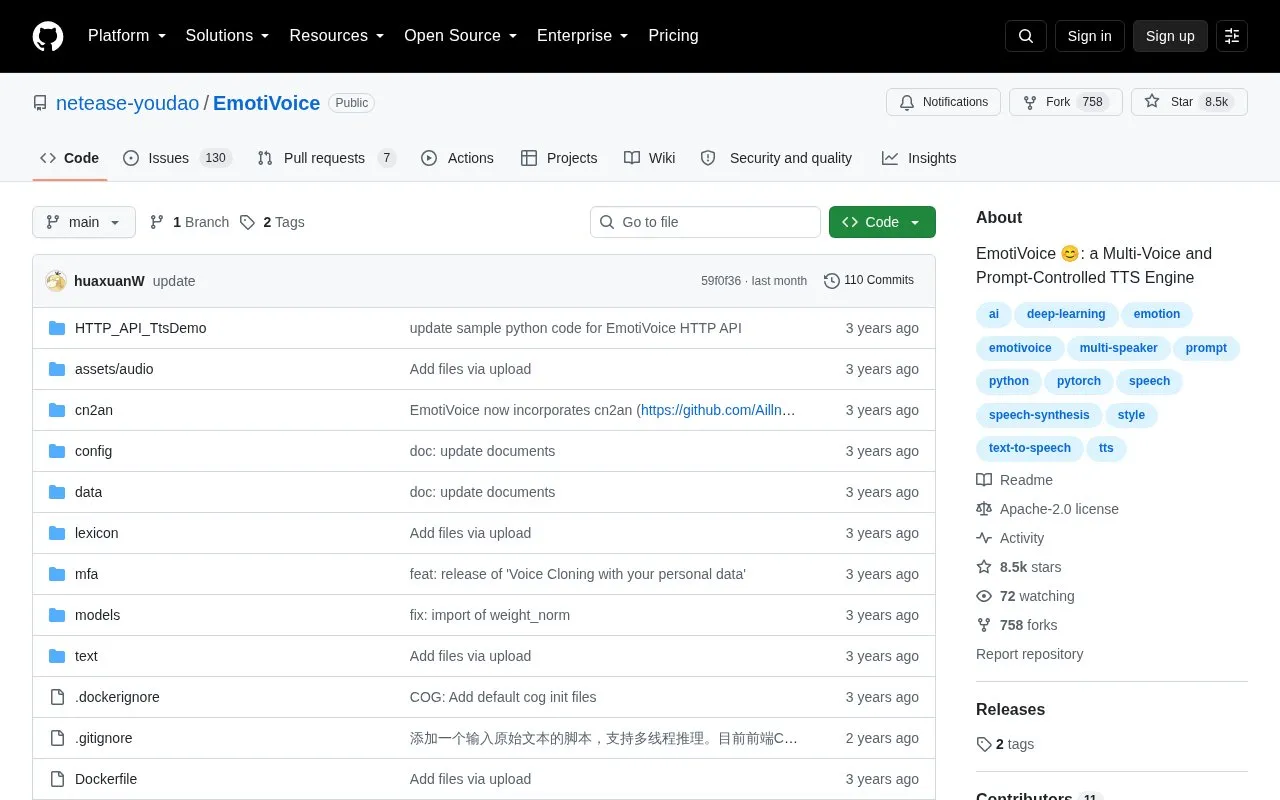
EmotiVoice is an open-source text-to-speech engine from NetEase Youdao, distributed as a GitHub repository. It synthesizes English and Chinese speech using over 2000 voices and supports prompt-based control of emotion and style, including happy, excited, sad and angry. It provides a web interface, a scripting interface for batch generation, an OpenAI-compatible TTS API and a separate HTTP API.
It can be run through a Docker image, a full conda installation, or a hosted demo on Replicate, and a Mac app was released in December 2023. Voice cloning with personal data is supported alongside DataBaker and LJSpeech recipes. Support for additional languages such as Japanese and Korean is listed as under development.
Tools and sites you could use instead, ranked by how closely they match.
ESPnet includes tools for end to end speech processing and related speech tasks.
The whisper.cpp project ports OpenAI’s Whisper speech recognition model to C and C++.
Audio-WebUI provides a web interface for different neural networks related to audio.
TTS-WebUI is a Gradio and React interface with extensions for speech, audio, and music generation tools.
Wispr Flow provides voice dictation that turns speech into text in text fields.
Vocol AI turns speech into text and shares AI-generated summaries, topic highlights and action items for voice collaboration.
Well-known listings from the same topic.
Tell us and an editor will check it.
Claim the listing and suggest updates yourself. An editor checks every claim first.


