

WhisperS2T is an optimized speech-to-text pipeline for the Whisper model with support for multiple inference engines.
Open source
24 alternativesFunASR supports speech recognition training and inference, streaming, punctuation, diarization, and model serving.
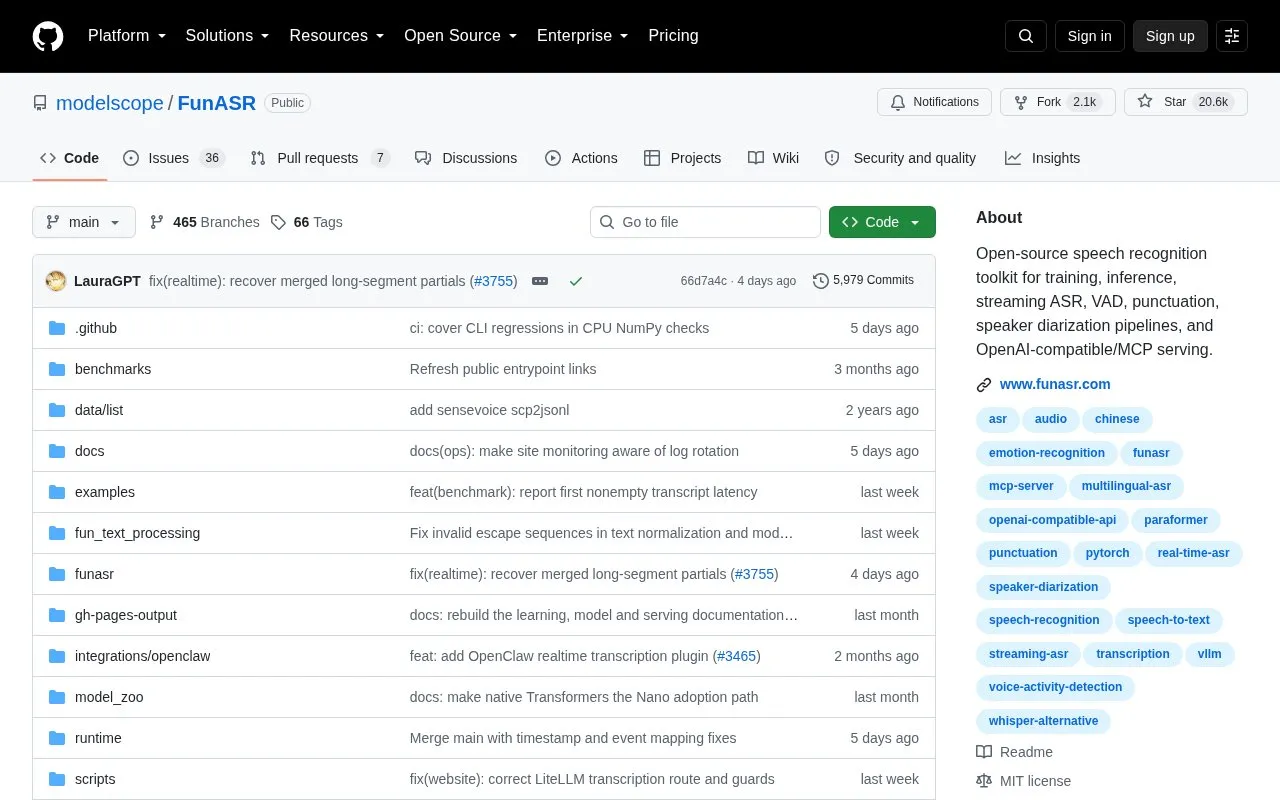
FunASR is an open-source speech recognition toolkit hosted on GitHub. It covers model training and inference, streaming speech recognition, voice activity detection (VAD), punctuation, and speaker diarization pipelines. It can also serve models through OpenAI-compatible and MCP interfaces.
The repository lists several model options. Fun-ASR-Nano covers Chinese, English, Japanese, and Chinese dialect groups and regional accents. Fun-ASR-MLT-Nano-2512 is a separate checkpoint covering 31 languages. SenseVoiceSmall is a CPU-first option that provides five-language ASR along with emotion and audio-event tags. Language coverage depends on the specific checkpoint, so the models should be chosen separately.
Limits: GPU use requires PyTorch and torchaudio wheels that match the user's NVIDIA driver. Speaker indices from the pipeline are local to each recording and do not identify known people. The speaker outputs come from the pipeline, not from the SenseVoiceSmall checkpoint itself. A browser-based Colab quickstart is available for transcribing audio without local setup, and uploaded audio is processed in that Colab environment.
Tools and sites you could use instead, ranked by how closely they match.
WhisperS2T is an optimized speech-to-text pipeline for the Whisper model with support for multiple inference engines.
Faster Whisper runs Whisper transcription through the CTranslate2 inference engine.
The whisper.cpp repository provides a C and C++ port of OpenAI’s Whisper model.
OpenQuack provides local voice dictation on macOS, inserting Whisper transcripts at the cursor.
CMUSphinx is an open source speech recognition system for mobile and server applications.
This speech recognition app transcribes audio uploaded as a file, recorded by microphone, or provided through a URL.
Well-known listings from the same topic.
Tell us and an editor will check it.
Claim the listing and suggest updates yourself. An editor checks every claim first.


