

TextureLab generates procedural textures, with its project page hosted on itch.io.
Material Maker
Use Material Maker to author procedural textures, with project files and related information available online.
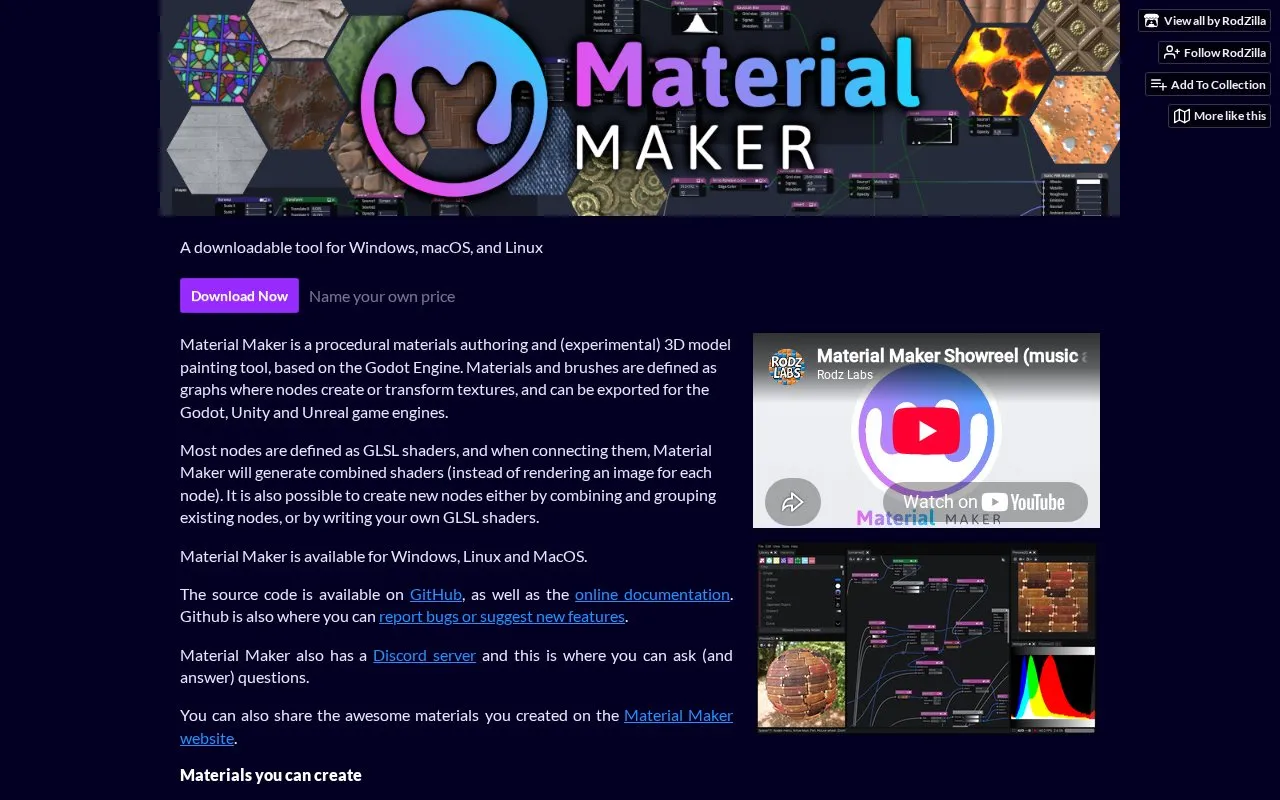
About Material Maker
Material Maker is a procedural materials authoring tool based on the Godot Engine, distributed as a downloadable tool for Windows, macOS and Linux. Materials and brushes are defined as node graphs, and most nodes are GLSL shaders: when nodes are connected, the tool combines shaders instead of rendering an image for each node, which makes textures described as combined shaders resolution independent. Materials can be exported for the Godot and Unity engines; for Unreal 4 the material must be set up manually because only images and shaders are generated, while for Unreal Engine 5 the tool generates a Python script that is run inside Unreal to build the material.
The tool also includes an experimental 3D model painting engine that can paint albedo, roughness, metallic, emission, normal map, depth and ambient occlusion at the same time, with Paint, Procedural and Mask layers. Custom nodes can be built by grouping existing nodes or by writing GLSL shaders, and the source code is available on GitHub alongside online documentation. Creating shader nodes requires some GLSL knowledge, and the painting engine is described as experimental.
Key features
- Node graph editor for creating procedural texture materials
- Combined-shader generation producing resolution-independent textures
- Exports ready-to-use materials for Godot and Unity engines
- Unreal Engine 5 export via a generated Python script
- Experimental painting engine painting multiple material components at once
- Sharing website for procedural materials and brushes
Best for: Game developers and technical artists who need to author procedural PBR materials and export them to Godot, Unity or Unreal.
Good for
- Shaders are combined rather than rendered per node, so combined-shader textures are resolution independent
- New group nodes and shader nodes can be created in the interface, with GLSL for shader nodes
- A dedicated website is available for sharing and downloading materials and brushes
Watch out for
- The 3D model painting engine is described as experimental
- Creating custom shader nodes requires some GLSL knowledge
- Unreal 4 export needs manual material setup because only images and shaders are generated
Material Maker at a glance
- Category
- Design & Creative › Design Assets & Inspiration
- Type
- Online tool
- Pricing
- Not confirmed. Check the site
- Platforms
- Linux, macOS, Web, Windows
- Open source
- Not stated
- Language
- English
- Last checked
- Oct 6, 2026 · Online when checked
- Listed
- Oct 5, 2026
Material Maker alternatives
Tools and sites you could use instead, ranked by how closely they match.
TextureLab supports procedural material creation through an open-source tool.

Generate procedural textures with TextureLab, a free, cross-platform, GPU-accelerated tool available through itch.io.
Create a printable eight-page zine from a single sheet of paper with this free browser-based maker.

MaterialX Library offers free PBR materials and textures for 3D artists and game developers, using the MaterialX open standard.

Build interfaces with MDB, a Material Design UI kit that offers components and templates for several frameworks.
Popular in Design Assets & Inspiration
Well-known listings from the same topic.
Arts and Cultureartsandculture.google.comFigmafigma.comUI Discoveryuidiscovery.comLS Graphicsls.graphicsToools.designtoools.designArtveeartvee.com





Material Maker FAQ
Which game engines can exported materials target?
Godot and Unity receive ready-to-use materials. For Unreal 4, images and shaders are generated but the material must be set up manually; for Unreal Engine 5, a Python script is generated and must be executed in Unreal to build the material automatically.
Can custom nodes be created?
Yes. New nodes can be made by combining and grouping existing nodes, or by writing your own GLSL shaders, which requires some GLSL knowledge.
What types of materials can be created?
Static PBR, dynamic PBR, raymarching and unlit materials. Static PBR exports textures such as albedo, metalness and roughness; dynamic PBR, raymarching and dynamic unlit materials are exported as shaders, with optional textures. New custom material types and export targets can be added.
Is something wrong or out of date?
Tell us and an editor will check it.
Own this website?
Claim this listing
Claim the listing and suggest updates yourself. An editor checks every claim first.