

mergerfs
mergerfs provides a FUSE union filesystem for managing files across multiple storage devices by combining them logically.
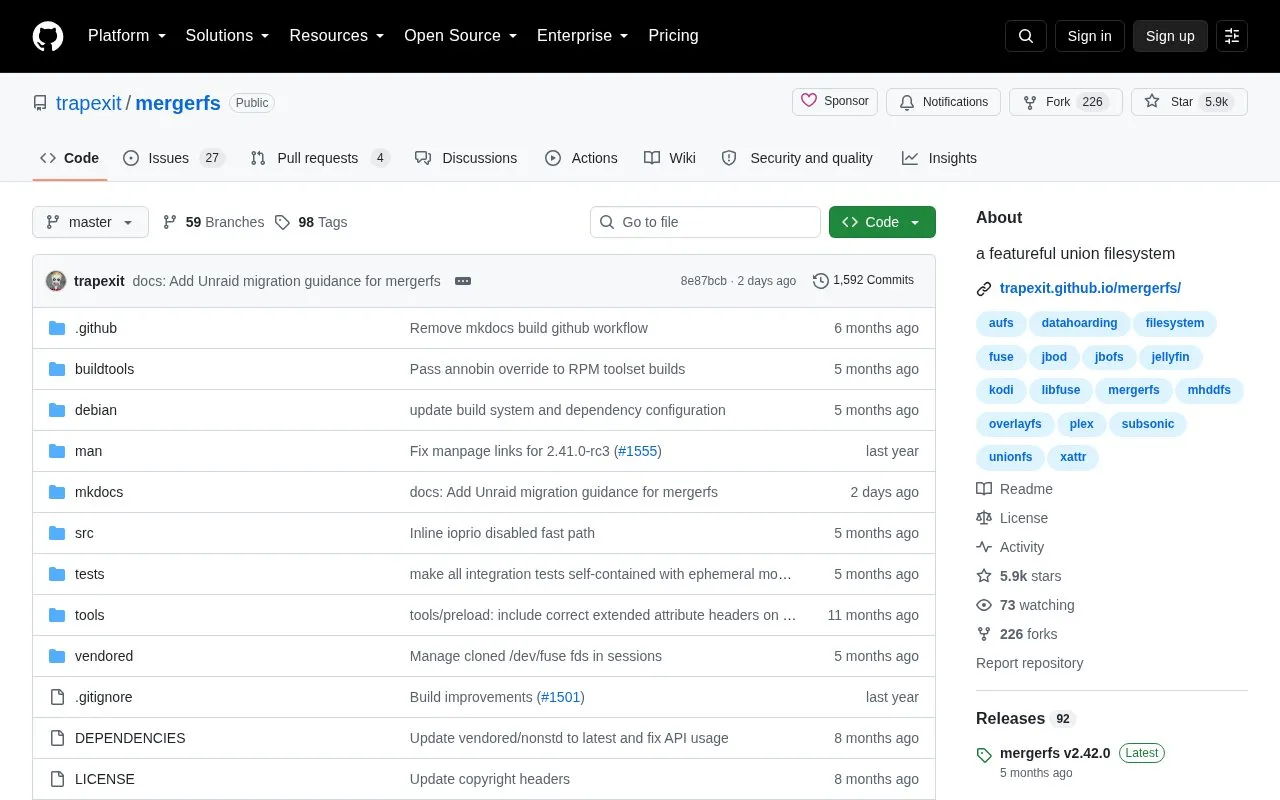
About mergerfs
mergerfs is a FUSE-based union filesystem that logically merges multiple filesystem paths into a single mount point. It acts as a proxy to the underlying paths, combining directory listings with deduplication and using policies to select the branch for new files and directories.
It works with filesystems of almost any type and any size, and allows branches to be added or removed without affecting the remaining data. It does not provide redundancy, parity calculation, splitting of files across branches, or overlay-style whiteouts.
Key features
- Combine multiple filesystem paths into single mount point
- Add or remove branches without affecting remaining data
- Policy-based selection for file creation placement
- File IO passthrough for near-native performance where supported
- Support for xattrs, chattr, POSIX ACLs and hard links
- Runtime configurable behavior and options
Best for: People managing files across numerous commodity storage devices through a single mount point.
Good for
- Works with filesystems of almost any type and any size
- Branches can be added or removed without impacting remaining data
- File IO passthrough for near-native performance where supported
Watch out for
- No redundancy or RAID-like parity calculation
- Does not split files across branches
- No read/write overlay or file whiteout like OverlayFS
mergerfs at a glance
- Website
- github.com/trapexit/mergerfs
- Category
- Software & Utilities › File Utilities
- Type
- Open-source project
- Pricing
- Not confirmed. Check the site
- Open source
- Not stated
- Language
- English
- Last checked
- Oct 5, 2026 · Online when checked
- Listed
- Oct 5, 2026
Guides for File Utilities
mergerfs alternatives
Tools and sites you could use instead, ranked by how closely they match.
Low Level Format explains zero-filling storage devices and offers the Lowvel tool for Windows.
Popular in File Utilities
Well-known listings from the same topic.
SDeletelearn.microsoft.com/en-us/sysinternals/downloa…PowerRenamelearn.microsoft.com/en-us/windows/powertoys/po…robocopylearn.microsoft.com/windows-server/administrat…VERTvert.shNanaZipnanazip.orgPhotonphotondev.netlify.app


mergerfs FAQ
How does mergerfs combine storage?
It merges filesystem paths, not block devices, and acts as a proxy, combining directory listings with deduplication.
How is the location for new files chosen?
When a file or directory is created, a policy runs to determine which branch is selected.
Does mergerfs provide redundancy or parity?
No. Redundancy and RAID-like parity calculation are listed as non-features.
Is something wrong or out of date?
Tell us and an editor will check it.
Own this website?
Claim this listing
Claim the listing and suggest updates yourself. An editor checks every claim first.