The Golm Metabolome Database supports searching and sharing mass spectra for biologically active metabolites measured with GC-MS.
PeptideAtlas
PeptideAtlas provides a proteomics data repository with database search, dataset builds, and data contribution options.
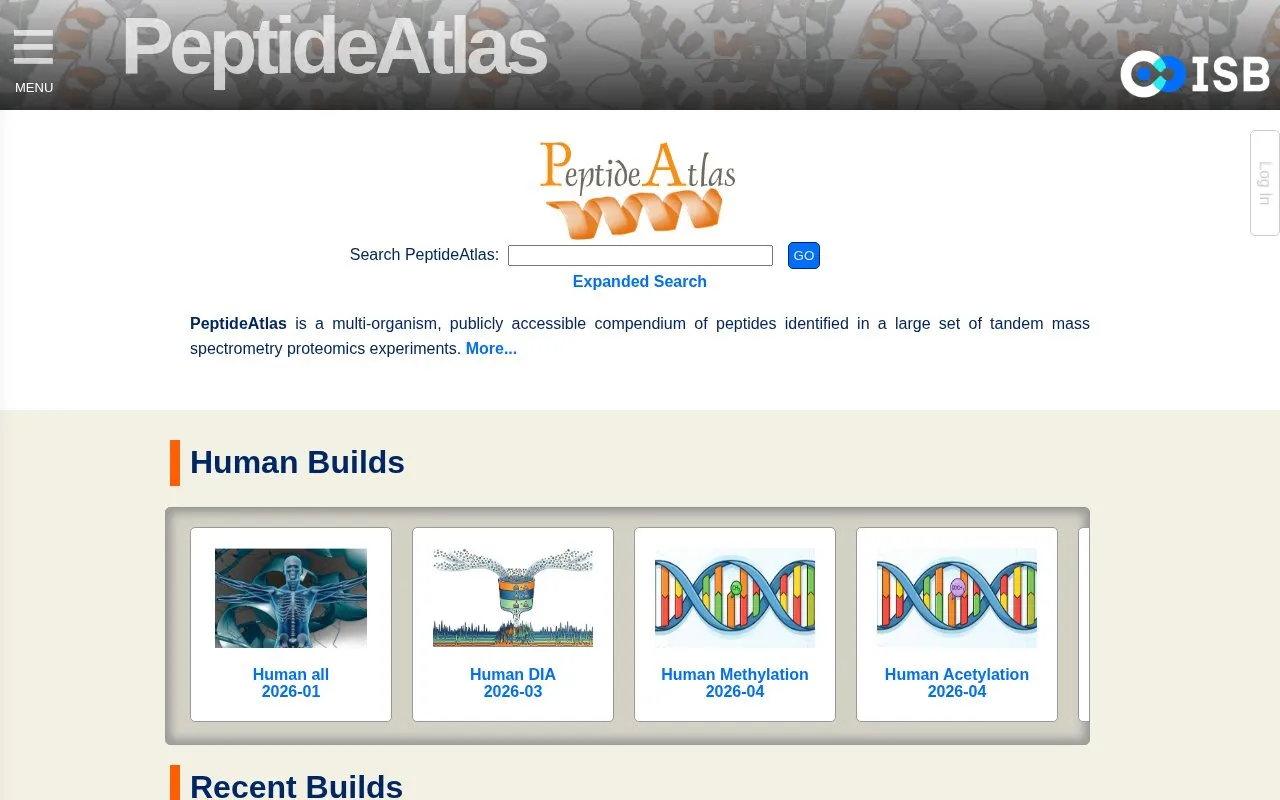
About PeptideAtlas
PeptideAtlas is a publicly accessible compendium of peptides identified in tandem mass spectrometry proteomics experiments for human, mouse, yeast, and several other organisms.
It collects mass spectrometer output files, searches them with current search engines and protein sequences, and processes results through the Trans-Proteomic Pipeline with identification probabilities and atlas-level false discovery rates. Results can be queried and browsed on the site, and raw data, search results, and full builds can be downloaded.
Key features
- Query and browse peptide and protein identifications by build
- Download raw data, search results, and full builds
- Access multi-organism builds for human, mouse, yeast and others
- View human builds for plasma, urine, and protein modifications
- Use ProteoMapper, RunAssessor, and THISP search tools
Best for: Researchers who need to query, browse, or reuse tandem mass spectrometry peptide identifications across organisms.
Good for
- Publicly accessible results across multiple organisms
- Uniform processing with identification probabilities and false discovery rates
- Raw data, search results, and builds available for download
PeptideAtlas at a glance
- Website
- peptideatlas.org
- Category
- Research & Data › Open Data & Datasets
- Type
- Website
- Pricing
- Not confirmed. Check the site
- Platforms
- Web
- Open source
- Not stated
- Last checked
- Oct 5, 2026 · Online when checked
- Listed
- Oct 5, 2026
PeptideAtlas alternatives
Tools and sites you could use instead, ranked by how closely they match.
The Rat Genome Database provides integrated genetic, genomic, physiological, pathway, and disease information with research tools.

ESS-DIVE supports searching and submitting environmental systems science data, with guidance and news about its research data infrastructure.

EMAGE provides searchable gene and protein records with filters for specimens, annotations, data sources, assays, and anatomy terms.

IEDA connects geoscience data systems for archiving, publishing, discovery, access, and visualization of research data.

BrainTx integrates transcriptome data related to the brain for visualization and analysis.
Popular in Open Data & Datasets
Well-known listings from the same topic.
data.worlddata.worldNASA APIapi.nasa.govCosmoSimcosmosim.orgdata.meudon.frdata.meudon.frState of Hawaiidata.hawaii.govPathway Commonspathwaycommons.org


PeptideAtlas FAQ
What organisms are covered?
Human, mouse, yeast, and several other organisms, with separate builds for animals, plants, and microbes.
What can be downloaded?
Raw mass spectrometer data, search results, and full atlas builds are available for download for other uses.
How are identifications processed?
Sequence and spectral library search results are processed through the Trans-Proteomic Pipeline to derive identification probabilities and atlas-level false discovery rates.
Is something wrong or out of date?
Tell us and an editor will check it.
Own this website?
Claim this listing
Claim the listing and suggest updates yourself. An editor checks every claim first.