

RCSB PDB supports searching, visualizing, downloading, and analyzing protein structures and related sequence, structure, and function data.
CATH
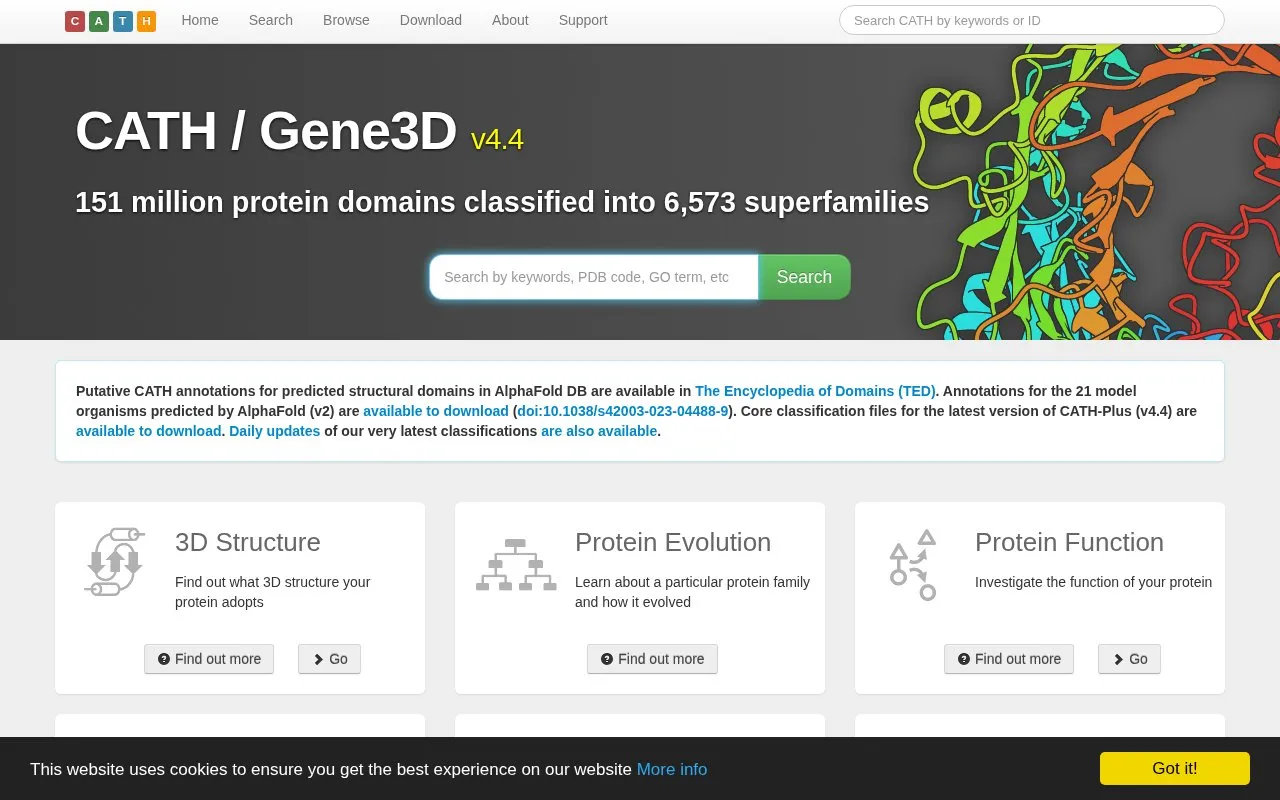
Search and browse CATH's database classifying protein structures, with options to find a protein structure.
About CATH
CATH is a protein structure classification database that groups protein domains by evolutionary relationships. Users can paste a protein sequence into search by sequence to find similar CATH domain structures and see where they match on the query.
CATH-Gene3D organizes related domains into superfamilies and functional families (FunFams), with sequence, structure, and functional annotation data. Matches link to domain and superfamily pages and can include FunFam IDs, Enzyme Commission and Gene Ontology annotations, and alignment conservation views.
Key features
- Search by sequence to find similar CATH structural domains
- Display positions of matching domain structures on query sequence
- Link results to matching domain and superfamily pages
- Group related domains into superfamilies and functional families
- Show EC and GO annotations for matching FunFams
- Map FunFam alignment conservation scores onto representative structure
Best for: Researchers and students who work with protein sequences and need domain classification, evolution, or function context.
Good for
- Sequence searches are described as finishing in less than one minute
- Combines sequence, structure, and functional annotation for domain relationships
- Aims to publish official classification releases every 12 months
CATH at a glance
- Website
- cathdb.info
- Category
- Research & Data › Open Data & Datasets
- Type
- Website
- Pricing
- Not confirmed. Check the site
- Platforms
- Web
- Open source
- Not stated
- Language
- English
- Last checked
- Oct 5, 2026 · Online when checked
- Listed
- Oct 5, 2026
CATH alternatives
Tools and sites you could use instead, ranked by how closely they match.

The SWISS-MODEL Repository contains annotated 3D protein structure models generated by a homology-modelling pipeline.

The Human Protein Atlas organizes protein information across tissues, brain, cells, blood, disease, structure, and interaction resources.

The Worldwide Protein Data Bank manages the public archive of 3D structures for proteins, nucleic acids, and complex assemblies.
PeptideAtlas provides a proteomics data repository with database search, dataset builds, and data contribution options.

The Cambridge Structural Database contains curated crystal-structure data for chemistry research.
Popular in Open Data & Datasets
Well-known listings from the same topic.
data.worlddata.worldNASA APIapi.nasa.govCosmoSimcosmosim.orgdata.meudon.frdata.meudon.frESS-DIVEess-dive.lbl.govState of Hawaiidata.hawaii.gov


CATH FAQ
How do I find CATH matches for my protein sequence?
Go to search by sequence, paste the protein sequence into the text box, click Search, and wait for results to finish.
What does a sequence search return?
Positions of the most similar CATH domain structures on the query, with links to the matching domain and superfamily, plus superfamily and FunFam IDs and EC and GO annotations.
How can I see conserved sites in a FunFam?
Run a sequence search against the FunFams and open the FunFam match Alignment page, which colors highly conserved residues red through to non-conserved residues blue and maps scores onto a representative structure.
Is something wrong or out of date?
Tell us and an editor will check it.
Own this website?
Claim this listing
Claim the listing and suggest updates yourself. An editor checks every claim first.