

Python bindings for Frog expose Dutch NLP functions such as tagging, lemmatization, named entity recognition, and parsing.
Open source
24 alternativespgmpy provides Python tools for causal inference and probabilistic reasoning.
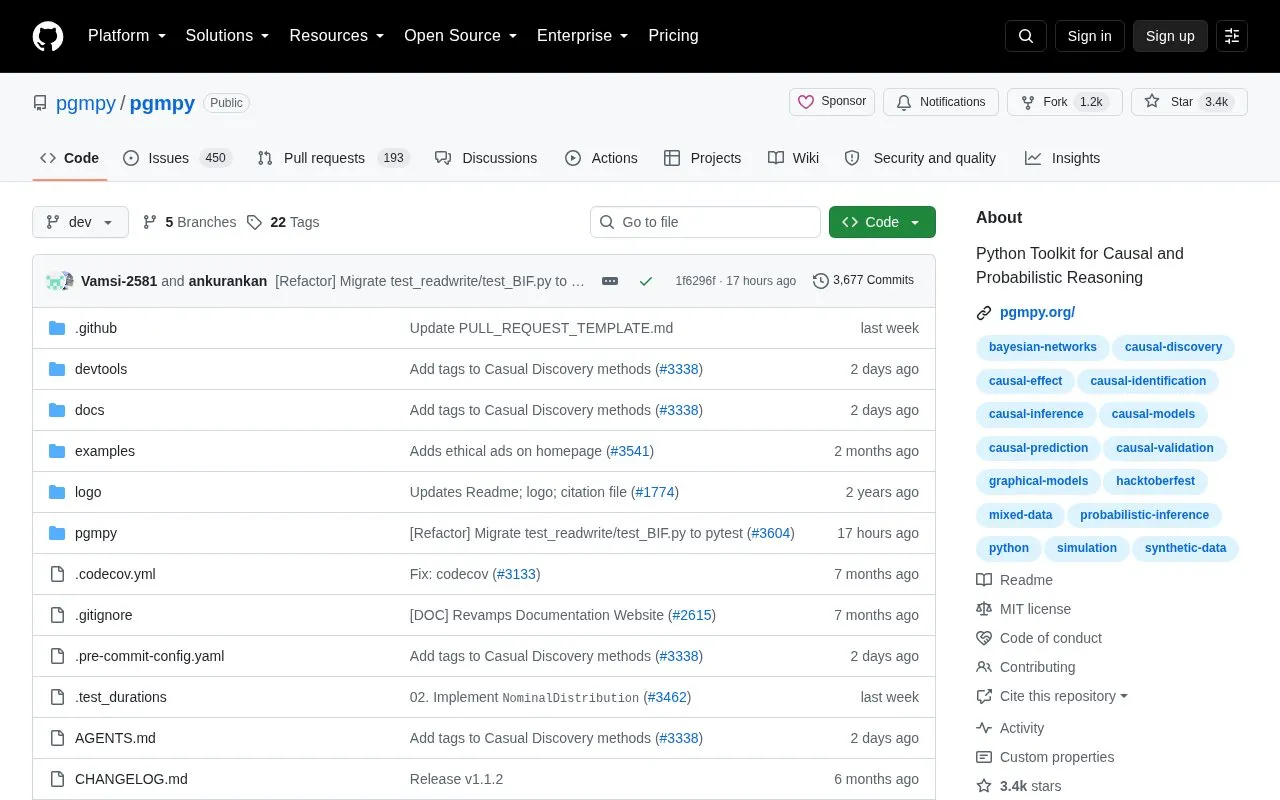
pgmpy is a Python toolkit for causal and probabilistic reasoning using graphical models. It provides data structures for DAGs, PDAGs, MAGs, PAGs, Bayesian Networks, Dynamic Bayesian Networks, and Structural Equation Models, with algorithms for causal discovery, identification, inference, validation, parameter estimation, and simulation.
Algorithms use a unified composable API and are scikit-learn compatible when possible, for direct use, use in sklearn pipelines, or as a base for higher-level tools. It is open source and installable from PyPI and conda-forge.
Tools and sites you could use instead, ranked by how closely they match.
Python bindings for Frog expose Dutch NLP functions such as tagging, lemmatization, named entity recognition, and parsing.
libpython-clj provides Python bindings that connect Python libraries with Clojure code.
Scalable, Portable and Distributed Gradient Boosting (GBDT, GBRT or GBM) Library.
xonsh is a Python-powered shell described as full-featured, cross-platform, and AI-friendly.
Run Python with RustPython, an open-source Python 3 interpreter written in Rust.
The scikit-learn documentation covers machine learning tools and methods for Python.
Well-known listings from the same topic.
Tell us and an editor will check it.
Claim the listing and suggest updates yourself. An editor checks every claim first.


