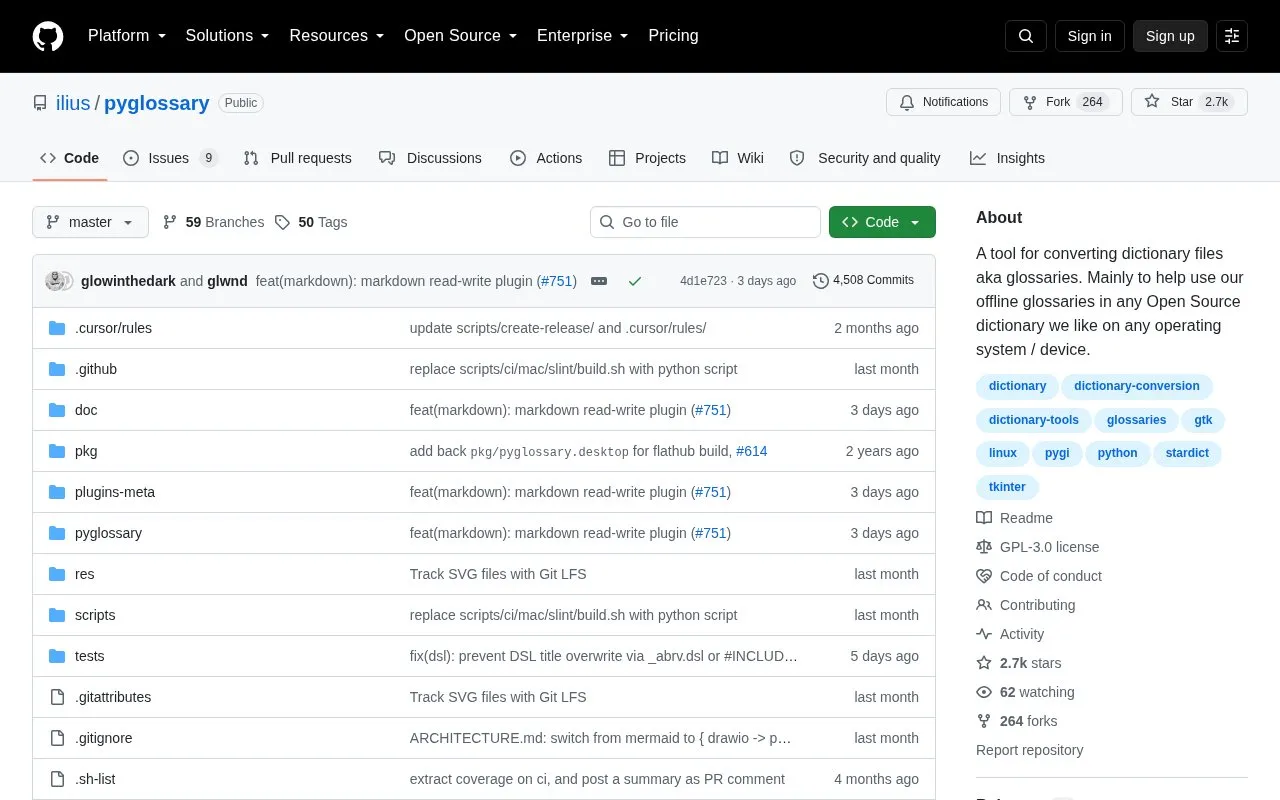
PyGlossary converts dictionary files, also called glossaries, so offline glossaries can be used in different open source dictionary applications on different operating systems and devices. It supports many input and output formats with different read and write coverage, and offers graphical, command-line, and interactive command-line interfaces.
It requires Python 3.12 or higher and works on GNU/Linux, Windows, Mac OS, FreeBSD and other common Unix-based systems. SQLite-based formats using .db are not detected by extension and must be selected manually, and some formats support only reading or only writing.
Key features
Converts offline glossary files between many dictionary formats
Reads and writes StarDict, Tabfile, CSV, Babylon BGL and Aard 2
Offers Gtk3, Gtk4, Qt6, wxPython and Tkinter graphical interfaces
Provides command-line and interactive command-line operation modes
Runs on Linux, Windows, Mac OS, FreeBSD and other Unix systems
Requires Python 3.12 or higher to run
Best for: People who need to reuse offline glossaries across different open source dictionary apps and operating systems.
Good for
Supports many dictionary, text, package and SQLite-based formats
Works on Linux, Windows, Mac OS, FreeBSD and other Unix systems
Offers several graphical interfaces plus command-line and interactive modes
Watch out for
Some formats support only reading or only writing
SQLite-based .db formats are not detected by extension and need manual selection
Requires Python 3.12 or higher, with extra packages for some interfaces