

QLoRA
Efficient fine-tuning of quantized language models is the focus of QLoRA, a method documented in this repository.
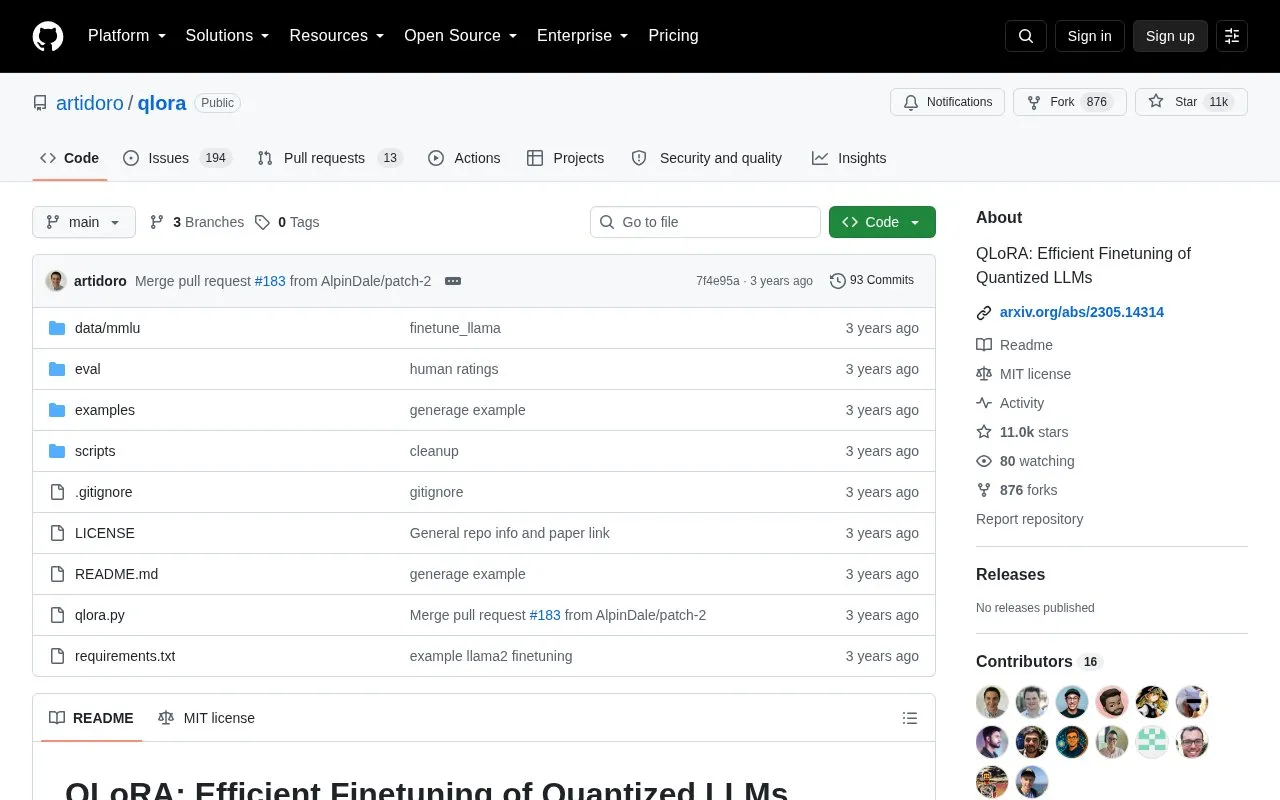
About QLoRA
QLoRA is an open-source repository documenting a method for finetuning quantized large language models. It backpropagates gradients through a frozen, 4-bit quantized pretrained model into Low Rank Adapters (LoRA), uses bitsandbytes for quantization with Hugging Face PEFT and transformers, and provides qlora.py for finetuning and inference with techniques including 4-bit NormalFloat, Double Quantization, and Paged Optimizers.
The repository resources are released under MIT license, while the Guanaco model family for 7B, 13B, 33B, and 65B base sizes requires access to LLaMA models and use in line with the LLaMA license. Guanaco is described as intended for research purposes and may produce problematic outputs.
Key features
- Backpropagates gradients through frozen 4-bit model into LoRA adapters
- 4-bit NormalFloat (NF4) data type for normally distributed weights
- Double Quantization to reduce memory by quantizing quantization constants
- Paged Optimizers to manage memory spikes during training
- Works with bitsandbytes, Hugging Face PEFT and transformers libraries
- Includes qlora.py starting point for finetuning and inference
Best for: Researchers and developers finetuning large language models with limited GPU memory.
Good for
- Designed to finetune a 65B parameter model on a single 48GB GPU
- Designed to preserve full 16-bit finetuning task performance
- Code released under MIT license including CUDA kernels for 4-bit training
Watch out for
- Guanaco models require access to base LLaMA models
- Guanaco is described as research-only and may produce problematic outputs
- Setup requires PyTorch plus source installs of accelerate, transformers and bitsandbytes
QLoRA at a glance
- Website
- github.com/artidoro/qlora
- Category
- Development › Developer Tools
- Type
- Open-source project
- Pricing
- Not confirmed. Check the site
- Open source
- Yes · Source code
- Language
- English
- Last checked
- Oct 5, 2026 · Online when checked
- Listed
- Oct 5, 2026
Guides for Developer Tools

QLoRA alternatives
Tools and sites you could use instead, ranked by how closely they match.

Neural networks in pure C are provided by notorch, a software library in this repository.
Open source
24 alternatives
Gitingest turns a Git repository into a plain text digest designed for use with language model prompts.

Weights & Biases supports model training, fine tuning, and management from experimentation through production.
Open source
24 alternatives
Neofuzz provides Python developers with a library for fuzzy text search.
Open source
24 alternatives
ai-i18n translates application localization files with language models and commits changed translations through GitHub Actions.

Gitingest turns a GitHub repository URL into a text digest suited to language model prompts.
Open source
24 alternativesPopular in Developer Tools
Well-known listings from the same topic.
AppDevToolsappdevtools.comCommand Not Foundcommand-not-found.comTestFlighttestflight.apple.com/join/A8GwCnq8Sourcegraphabout.sourcegraph.comProject Wallaceprojectwallace.comCarbon Calculatorwebsitecarbon.com


QLoRA FAQ
What hardware example is given for QLoRA?
The source describes finetuning a 65B parameter model on a single 48GB GPU.
How do I start finetuning with the code?
Use qlora.py, for example: python qlora.py --model_name_or_path on the Alpaca dataset.
What is required to use the Guanaco models?
They require access to the LLaMA models and use in line with the LLaMA license.
Is something wrong or out of date?
Tell us and an editor will check it.
Own this website?
Claim this listing
Claim the listing and suggest updates yourself. An editor checks every claim first.