

QWED
QWED verifies LLM outputs, tool calls, code, schemas, and agent state before production execution.
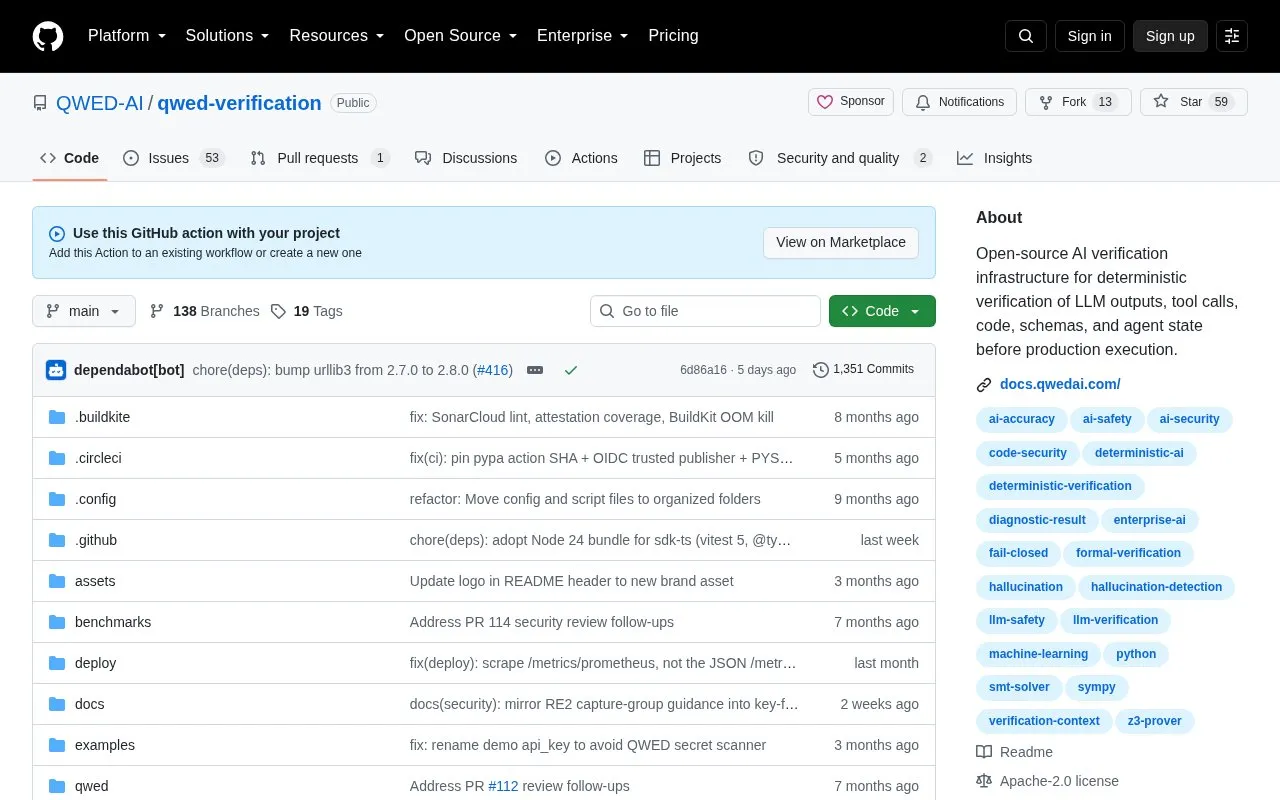
About QWED
QWED is an open-source (Apache-2.0) verification layer that checks claims in LLM and AI-agent output before production execution. It uses deterministic engines, including SymPy, Z3, SQLGlot and Python AST analysis, to verify LLM outputs, tool calls, code, schemas and agent state. A claim it cannot check fails closed and is never reported as verified. It runs in your own environment as a Python library, CLI, self-hosted API or Docker image, with SDKs for TypeScript, Go and Rust.
Results use a DiagnosticResult that separates whether a result was established deterministically (VERIFIED, UNVERIFIABLE, BLOCKED) from whether the checked output may be acted on (ADMIT, BLOCKED). VERIFIED results carry a proof_ref, a SHA-256 commitment to the evidence. The project does not check intent, does not cover every domain, and its results depend on the soundness of its engines. Natural-language checks use an LLM to translate text into a formal statement, and that translation is not itself verified; prompts go to the configured provider unless a local model such as Ollama is used.
Key features
- Deterministic verification of LLM and AI-agent output using SymPy, Z3, SQLGlot and Python AST.
- Fails closed: claims it cannot check are never reported as verified.
- Separates verification status (VERIFIED, UNVERIFIABLE, BLOCKED) from admission decision (ADMIT, BLOCKED).
- Returns DiagnosticResult with proof_ref, a SHA-256 commitment to evidence for verified results.
- Runs as Python library, CLI, self-hosted API or Docker image in your environment.
- Offers SDKs for TypeScript, Go and Rust.
Best for: Developers and teams building LLM or AI-agent systems who need deterministic, self-hosted checks on outputs before execution.
Good for
- Open source under Apache-2.0 license.
- Uses deterministic engines and fails closed when a claim cannot be checked.
- Can run in the user's own environment as a Python library, CLI, self-hosted API or Docker image, with TypeScript, Go and Rust SDKs.
Watch out for
- Does not check intent; verifies the formal statement it is given or extracts.
- Claims outside supported engines return UNVERIFIABLE, and results depend on the soundness of SymPy, Z3, SQLGlot, CrossHair and QWED's rule sets.
- Natural-language checks rely on an LLM for translation that is not itself verified; prompts go to the configured provider unless a local model is used.
QWED at a glance
- Category
- Privacy & Security › Security Tools
- Type
- Open-source project
- Pricing
- Not confirmed. Check the site
- Open source
- Yes · Source code
- Language
- English
- Last checked
- Oct 6, 2026 · Online when checked
- Listed
- Oct 5, 2026
Guides for Security Tools
QWED alternatives
Tools and sites you could use instead, ranked by how closely they match.

This repository organizes formal verification and model-checking resources, techniques, and tools.
Open source
24 alternatives
Manage two-step verification tokens on Android with Aegis Authenticator, a free, open-source app.

Facia provides deepfake and liveness detection for identity verification and authentication.

Plexiglass helps detect and protect against vulnerabilities in large language models.
Open source
24 alternatives
The action firewall for AI agents. Enforce policy and human approval before risky tool calls, shell commands, workflows, and production changes, with auditable evidence.

Cynative provides security agents that audit cloud, code, and runtime environments for exposure and privilege issues.
Open source
24 alternativesPopular in Security Tools
Well-known listings from the same topic.
Online Password Hash Crackonlinehashcrack.comOTP Authapps.apple.com/app/otp-auth/id659877384MD5 reverse lookupmd5.gromweb.comMozilla SSLssl-config.mozilla.orgchallenges.rechallenges.reGoPlus Locker V3gopluslabs.io


QWED FAQ
What happens when QWED cannot verify a claim?
A claim that QWED cannot check is never reported as verified; it fails closed and returns UNVERIFIABLE.
Does QWED verify natural-language claims?
It uses an LLM to translate text into a formal statement, and that translation is not itself verified. Prompts go to the configured provider unless a local model such as Ollama is used.
What Python version does QWED require and how is it installed?
Python 3.10 or newer is required. Install the core engines and CLI with pip install qwed; optional extras add the FastAPI server, CrossHair symbolic engine, PII masking, and framework integrations.
Is something wrong or out of date?
Tell us and an editor will check it.
Own this website?
Claim this listing
Claim the listing and suggest updates yourself. An editor checks every claim first.