

Distrobox runs Linux distributions inside containers and provides documentation and downloads.
Redroid
redroid runs Android in a multi-architecture cloud environment with GPU support, according to its documentation.
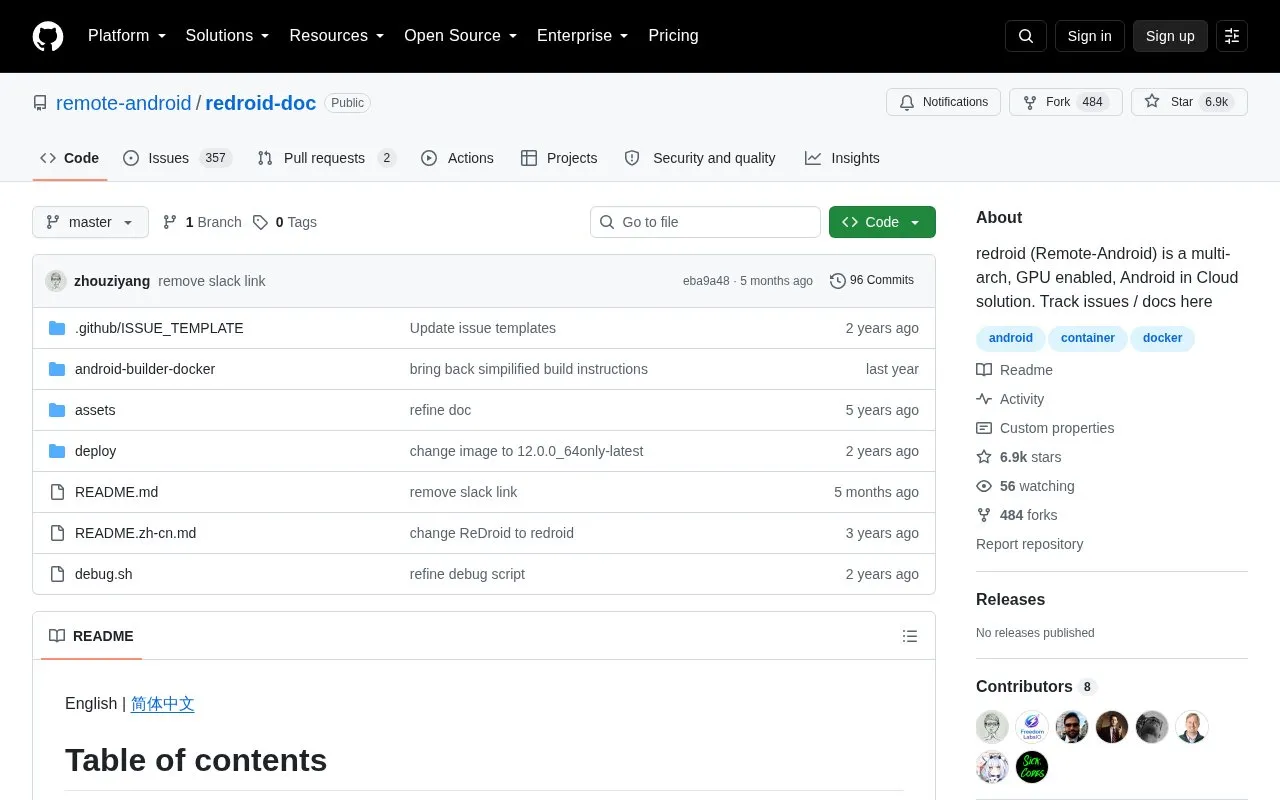
About Redroid
redroid (Remote anDroid) is a GPU-accelerated Android in Cloud solution. It runs Android instances on a Linux host through Docker, podman, or Kubernetes, and multiple instances can run on one host. It supports both arm64 and amd64 architectures. The project lists uses including cloud gaming, virtual phones, and automation testing. Published images cover Android 8.1 through Android 16, with 64-bit-only variants for Android 12 through 16.
Setup requires a Linux host with certain kernel features enabled and the binder and ashmem kernel modules loaded. The quick start example runs the container with the --privileged flag. The documentation warns that the adb port should not be exposed on a public network, because the container or host may be compromised. By default, the GPU mode is set to guest, which uses software rendering. GPU-accelerated rendering requires changing the setting to host.
Key features
- Runs multiple Android instances on one Linux host using Docker, podman, or Kubernetes
- Supports arm64 and amd64 architectures
- Published images for Android 8.1 through Android 16
- Selectable GPU mode: software rendering, host GPU rendering, or auto-detect
- Configurable display width, height, DPI, and frame rate at boot
- Runs arm apps on x86 instances via libhoudini, libndk_translation, or QEMU translator
Best for: Developers and operators who need to run many Android instances on Linux servers for cloud gaming, virtual phones, or automated testing.
Good for
- Offers published images for a wide range of Android versions, from 8.1 to 16
- Supports both arm64 and amd64 Linux hosts
- Exposes configuration options for display and proxy or DNS settings
Watch out for
- Requires specific kernel features and the binder and ashmem modules to be available on the host
- The quick start example runs containers with the --privileged flag
- The default GPU mode uses software rendering; host GPU rendering must be set explicitly
Redroid at a glance
- Category
- Software & Utilities › Linux Apps
- Type
- Open-source project
- Pricing
- Not confirmed. Check the site
- Platforms
- Android, Linux
- Open source
- Not stated
- Language
- English
- Last checked
- Oct 6, 2026 · Online when checked
- Listed
- Oct 5, 2026
Redroid alternatives
Tools and sites you could use instead, ranked by how closely they match.

Heads provides a minimal Linux boot environment running as a coreboot or LinuxBoot ROM payload for laptops, workstations, and servers.
Open source
24 alternatives
WinApps runs Windows applications such as Microsoft Office or Adobe software on Linux and integrates them with GNOME or KDE.

OrbStack runs containers and Linux virtual machines on macOS, according to its product page.

Tart builds, runs, and manages macOS and Linux virtual machines, with remote storage and integrations such as GitHub and GitLab.

The utils repository collects custom scripts and dotfiles, mainly for Linux systems.
Open source
24 alternativesPopular in Linux Apps
Well-known listings from the same topic.
AltBoxaltbox.devThe Levelatorarchive.org/details/conversationsnetwork_org-l…Alacrittyalacritty.orgShellScriptshellscript.shghostwriterghostwriter.kde.orgLibrebootlibreboot.org


Redroid FAQ
Which Android versions are available?
The documentation lists images for Android 8.1, 9, 10, 11, 12, 13, 14, 15, and 16. Android 12 through 16 also have 64-bit-only images.
Can arm apps run on x86 instances?
The documentation says arm apps can run on x86 instances through libhoudini, libndk_translation, or the QEMU translator. It also states that published images already include libndk_translation.
How can I view the Android screen?
The quick start connects with adb to port 5555 and displays the screen with scrcpy, for example with scrcpy -s localhost:5555. For a remote host, the documentation says to replace localhost with the host's IP address.
Is something wrong or out of date?
Tell us and an editor will check it.
Own this website?
Claim this listing
Claim the listing and suggest updates yourself. An editor checks every claim first.