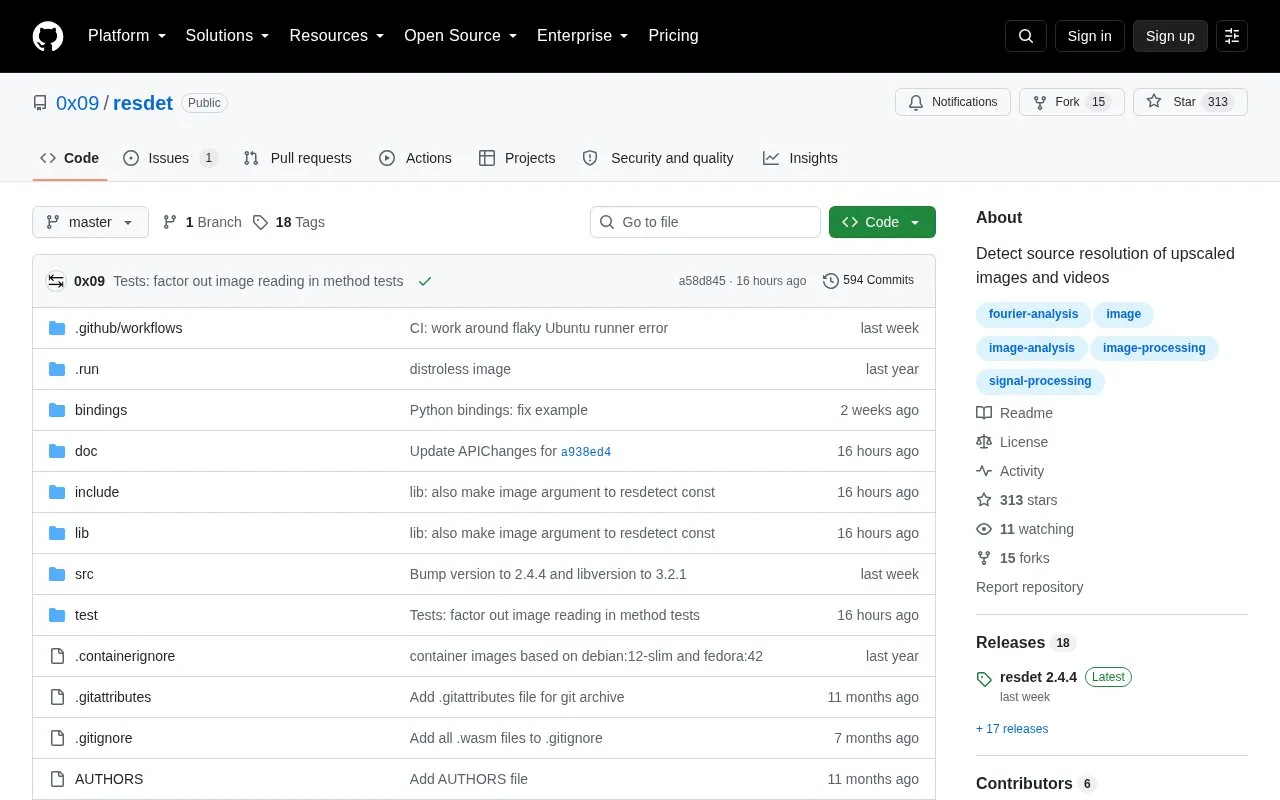
resdet is a command-line tool and C library that attempts to detect upscaling in images or video frames and identify the original resolution. It can be used via the command line, as a library with resdet.h and libresdet, and has an online version. It includes Python and JavaScript bindings and built-in readers for PFM, PGM, and Y4M.
Filtering and compression artifacts can harm accuracy, and results depend on using images as close to the source as possible. Detection can be more accurate when performed in the same colorspace the image was resized in.
Key features
Detect source resolution of upscaled images and videos
Check for upscaling with quiet verification mode
Analyze video frames by offset and frame count
Use as C library with resdet.h and libresdet
Offers Python and JavaScript bindings via Emscripten
Read PFM, PGM, and Y4M without external dependencies
Best for: People checking images or video frames for upscaling and original resolution benefit most.
Good for
Provides command-line tool, C library, and online version
Works standalone with built-in PFM, PGM, and Y4M readers
Supports loaders via libpng, libjpeg, MagickWand, and FFmpeg
Watch out for
Filtering and compression artifacts can significantly harm accuracy
Requires clear, detailed images close to the source for best results
Accuracy may depend on matching the original resize colorspace
It tries to identify inversions where the Discrete Cosine Transform zero-crossings fall at the offset the source was upscaled from.
How can I get more accurate results?
Use images as close to the source as possible, since filtering and compression artifacts can harm accuracy and clearer, more detailed images fare better.
How should I test video?
For compressed video, choose a highly detailed keyframe with a low quantizer; multiple frames can be analyzed together.
Is something wrong or out of date?
Tell us and an editor will check it.
Own this website?
Claim the listing and suggest updates yourself. An editor checks every claim first.