
If the Moon Were Only 1 Pixel maps solar system objects in a scale model that begins with a one-pixel Moon.
Space Time
A browser-based 3D universe explorer combines the solar system, stars, deep-sky objects, satellites, and galaxies.
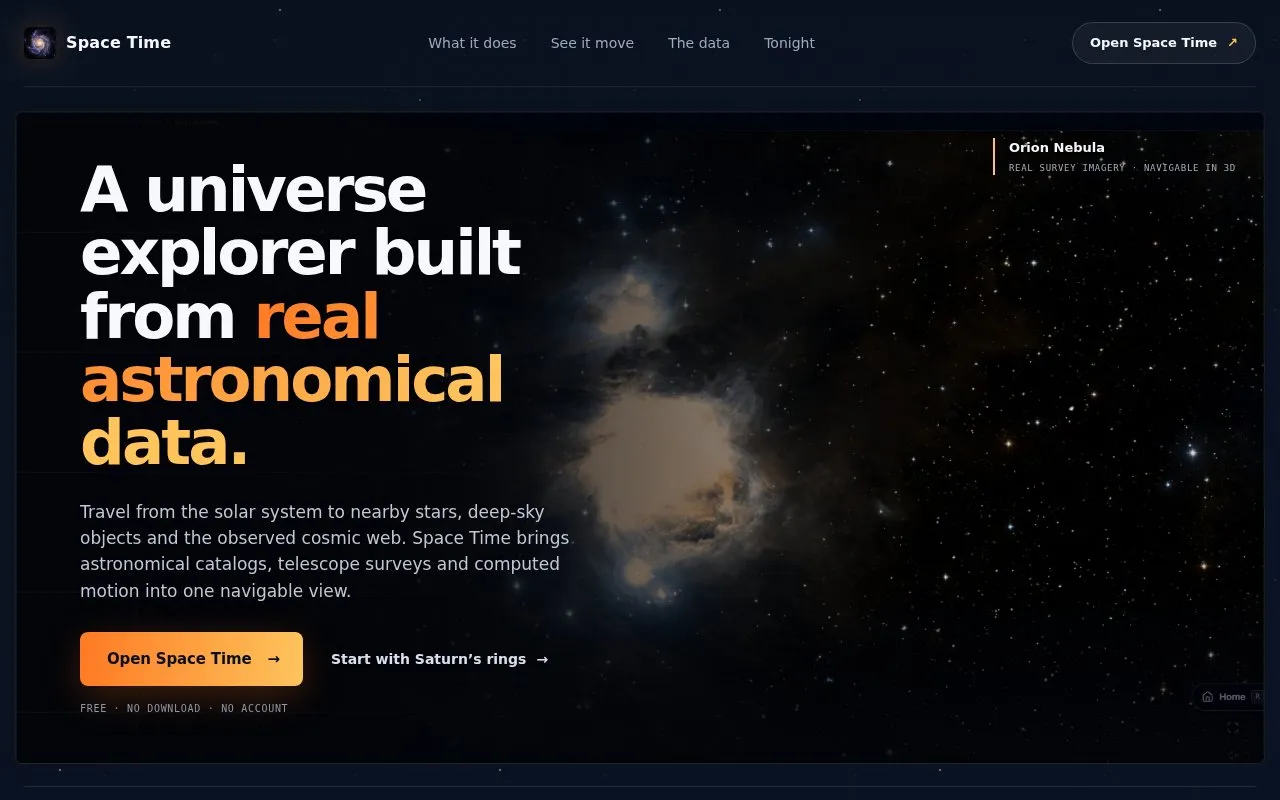
About Space Time
Space Time is a browser-based 3D universe explorer built from astronomy data. It places the solar system, 2.5 million mapped stars, 32,000+ deep-sky objects, SGP4 satellite predictions, and 630,000+ DESI galaxies in one continuous scene, with search, selection and a shared time system from planets to large-scale structure. It also offers twenty-five sky cultures, countdowns to eclipses and other sky events, surface views from other worlds, and shareable recorded tours.
Some sky, planet, Tonight and station-pass functions load offline after one online visit, and push alerts can reach a phone. Planetary views may use archived Hubble OPAL maps with observation epoch and filters shown, rather than live forecasts. Catalog galaxies use available redshift data, and generic close-range structure is identified as a reconstruction. The site is free in the browser and does not require an account.
Key features
- Continuous 3D view from the solar system to large-scale cosmic structure.
- Search for an object, travel there, and keep moving through the scene.
- Swap constellation figures, names and stories across twenty-five sky cultures.
- Surface view: land on planets or moons and select objects in local sky.
- Live Earth, Sun, aurora, weather and visible-target data; offline sky after one online visit.
- Source chips and public evidence pages separate measured values, reconstructions and assumptions.
Best for: People who want a browser-based way to explore astronomy data across scales and observers planning sessions or using the sky offline.
Good for
- Free in browser with no account required.
- Combines multiple astronomical datasets, including Gaia and HYG proper motion, DESI galaxies and SGP4 satellite predictions.
- Source chips and public evidence pages identify engines, catalogs, dates, measured values, reconstructions and assumptions.
Watch out for
- Offline use for sky, planets, Tonight and station passes requires one prior online visit.
- Some planetary images are dated archived Hubble OPAL maps, not live forecasts.
- Radial velocity is included only for stars with a catalog measurement; generic close-range structure is marked as a reconstruction.
Space Time at a glance
- Website
- space.pointdynamics.com
- Category
- Education & Learning › Space & Astronomy
- Type
- Website
- Pricing
- Not confirmed. Check the site
- Platforms
- Web
- Open source
- Not stated
- Language
- English
- Last checked
- Oct 6, 2026 · Online when checked
- Listed
- Oct 5, 2026
Space Time alternatives
Tools and sites you could use instead, ranked by how closely they match.

Atlas of Space interactively explores planets, moons, asteroids, and other objects in the Solar System.
The Map of the Universe interactively maps 200,000 galaxies from the Milky Way toward the observable universe.

Universe Atlas visualizes scale from the observable universe to a proton, with real stars and planets shown at their measured sizes and distances.
Space Object Comparison interactively compares the sizes of planets and stars.

Explore the Solar System, change time, and inspect worlds in this browser-based 3D space simulation.
Popular in Space & Astronomy
Well-known listings from the same topic.
Imagesimages.nasa.govNASAnasa.govHistorynasa.gov/historyFirstMenOnTheMoonfirstmenonthemoon.comVisible Earthvisibleearth.nasa.govJPL Photojournalphotojournal.jpl.nasa.gov


Space Time FAQ
Do I need an account to use Space Time?
No. The homepage states it is free in the browser and requires no account.
Can Space Time work offline?
After one online visit, the sky, planets, Tonight and station passes load offline, and sky alerts can arrive as push notifications.
How can I share an exploration?
Record what you do in the app, save it as a script, and publish it as a tour link; viewers watch in presentation mode and nothing runs before they press Play.
Is something wrong or out of date?
Tell us and an editor will check it.
Own this website?
Claim this listing
Claim the listing and suggest updates yourself. An editor checks every claim first.