

SymPy
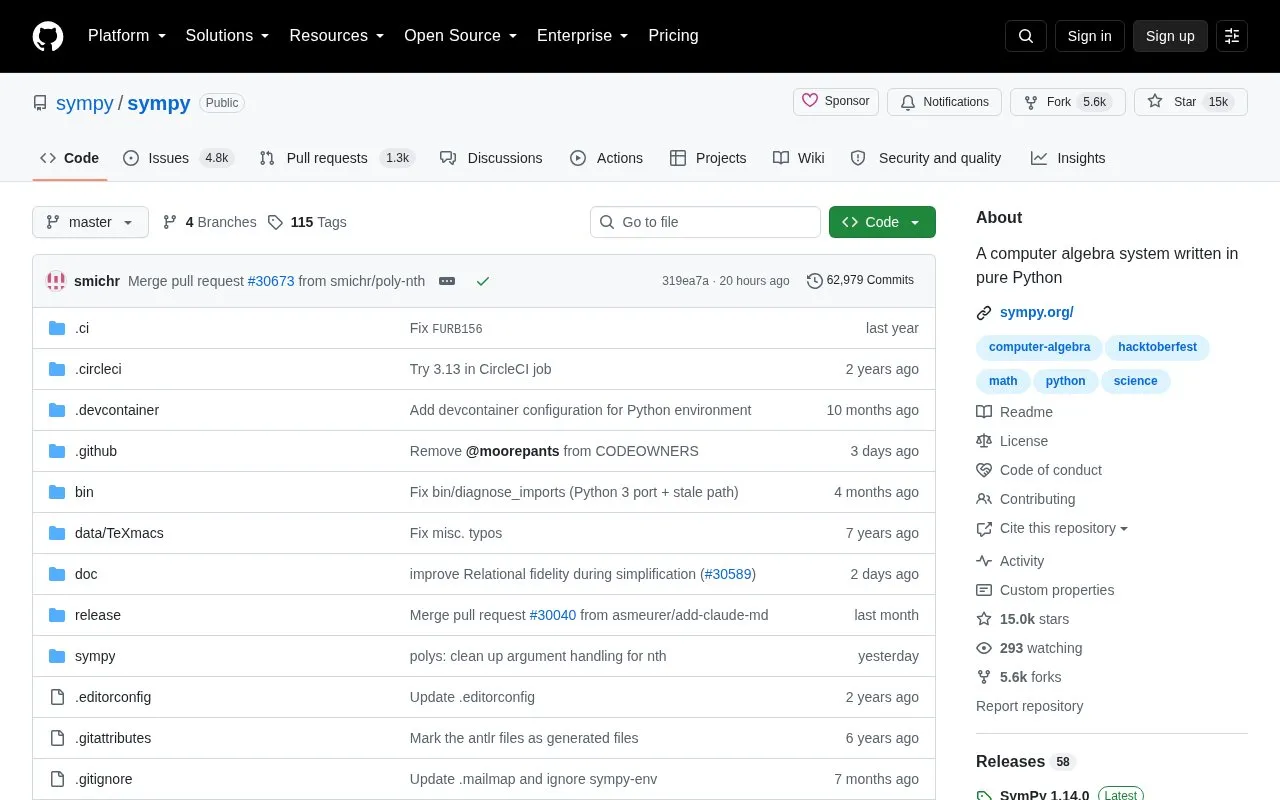
SymPy is a computer algebra system written in pure Python.
About SymPy
SymPy is a computer algebra system written in pure Python. It lets Python users work with symbolic expressions in code, with an isympy console available for interactive use. The project is distributed through PyPI, Anaconda and its GitHub source repository, and its documentation is at docs.sympy.org.
Pricing is not clearly stated.
Key features
- Defines symbols and computes results such as series expansions from Python code
- isympy loads the SymPy namespace and executes common commands
- pip install sympy installs from PyPI
- conda install -c anaconda sympy installs from Anaconda
- A cloned GitHub source tree can be installed with pip install .
- Documentation can be built locally from the doc folder with make html
Best for: Python users who need symbolic mathematics and computer algebra in their code.
SymPy at a glance
- Website
- github.com/sympy/sympy
- Category
- Development › Developer Tools
- Type
- Open-source project
- Pricing
- Not confirmed. Check the site
- Details verified
- Oct 22, 2026 · Official source
- Open source
- Yes · Source code
- Language
- English
- Last checked
- Oct 6, 2026 · Online when checked
- Listed
- Oct 5, 2026
Guides for Developer Tools

SymPy alternatives
Tools and sites you could use instead, ranked by how closely they match.

Use scikit-image, a Python software library, to process digital images.

GoCV provides computer vision in Go using OpenCV, with support for DNN, CUDA, OpenCV Contrib, and OpenVINO.
PyDy provides Python tools for modeling the dynamics of multibody mechanical systems.

Conda manages binary packages and software environments across major operating systems and platforms.

Jupytext lets users represent Jupyter notebooks as Markdown documents or Julia, Python, and R scripts.
Open source
24 alternatives
Python developers can use Zipline’s event-driven library to backtest algorithmic trading strategies.
Open source
24 alternativesPopular in Developer Tools
Well-known listings from the same topic.
AppDevToolsappdevtools.comCommand Not Foundcommand-not-found.comTestFlighttestflight.apple.com/join/A8GwCnq8Sourcegraphabout.sourcegraph.comProject Wallaceprojectwallace.comCarbon Calculatorwebsitecarbon.com


Is something wrong or out of date?
Tell us and an editor will check it.
Own this website?
Claim this listing
Claim the listing and suggest updates yourself. An editor checks every claim first.