
OPEN-ADAS lets users search atomic data by element, ion, wavelength, or other parameters.
The Atomic Line List
The Atomic Line List compiles calculated wavelengths for allowed, intercombination, and forbidden atomic transitions.
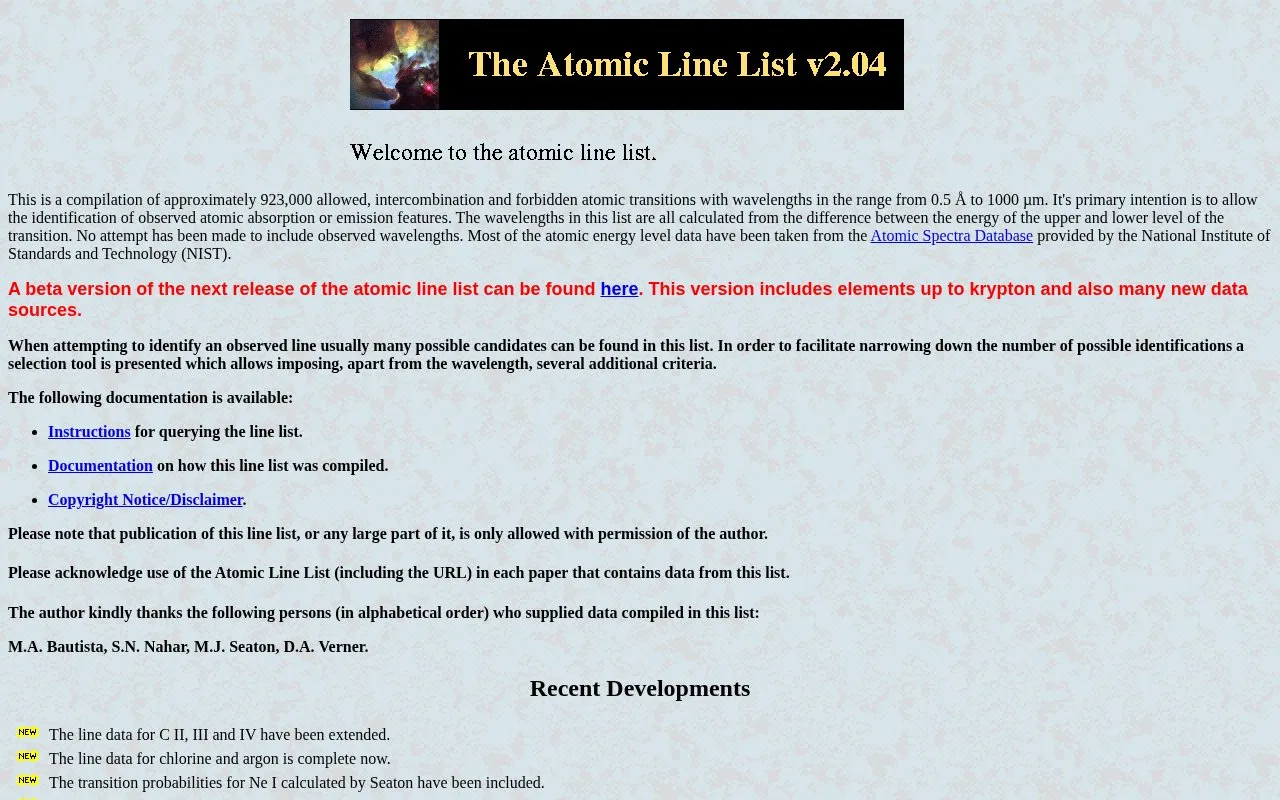
About The Atomic Line List
The Atomic Line List is a compilation of about 923,000 allowed, intercombination, and forbidden atomic transitions, with wavelengths from 0.5 Å to 1000 µm. Its stated purpose is to help identify observed atomic absorption or emission features. Each wavelength is calculated from the difference between the energy of the upper and lower levels of the transition. No observed wavelengths are included. Most of the energy level data come from the Atomic Spectra Database provided by the National Institute of Standards and Technology (NIST). The source notes that identifying a single observed line often produces many candidates, so a selection tool lets users filter results by criteria in addition to wavelength.
The list is hosted by the Department of Physics and Astronomy at the University of Kentucky and maintained by Peter van Hoof of the Royal Observatory of Belgium. The current listed version is 2.04, created on October 19, 1999. A beta version of the next release, which covers elements up to krypton, is linked from the site. Publication of the list, or any large part of it, requires the author's permission. Papers that use data from the list must acknowledge the Atomic Line List and include its URL.
Key features
- Approximately 923,000 allowed, intercombination, and forbidden atomic transitions
- Wavelength coverage from 0.5 Å to 1000 µm
- Wavelengths calculated from upper and lower energy level differences
- Selection tool that filters candidate lines by wavelength and other criteria
- Beta preview of the next release, including elements up to krypton
- Recent updates to line data for C II–IV, chlorine, and argon
Best for: Astronomers, physicists, and spectroscopy researchers who need to identify observed atomic absorption or emission lines by wavelength.
Good for
- Covers a large number of atomic transitions across a wide wavelength range
- Selection tool helps narrow down possible identifications for an observed line
- Most energy level data are drawn from NIST's Atomic Spectra Database
Watch out for
- Wavelengths are calculated, and no observed wavelengths have been included
- Publishing the list or a large part of it requires the author's permission
- The next release is available only as a beta version
The Atomic Line List at a glance
- Website
- linelist.pa.uky.edu/atomic
- Category
- Research & Data › Open Data & Datasets
- Type
- Website
- Pricing
- Not confirmed. Check the site
- Platforms
- Web
- Open source
- Not stated
- Last checked
- Oct 6, 2026 · Online when checked
- Listed
- Oct 5, 2026
The Atomic Line List alternatives
Tools and sites you could use instead, ranked by how closely they match.
NIST’s Atomic Spectral Line Broadening Bibliographic Database provides references about atomic spectral line broadening, from 1889 onward.

Browse Kurucz atomic line lists alongside links to related astronomy and molecular databases.

Hydro-Québec's open data portal provides information about electricity infrastructure, consumption, and energy transition goals.

WorldViews supports compiling and analyzing schoolbook text corpora with structured, machine-readable information.

The Global Heat Flow Database compiles authenticated measurements of Earth's heat flow through collaboration between researchers and industry.
Popular in Open Data & Datasets
Well-known listings from the same topic.
data.worlddata.worldNASA APIapi.nasa.govCosmoSimcosmosim.orgdata.meudon.frdata.meudon.frESS-DIVEess-dive.lbl.govState of Hawaiidata.hawaii.gov


The Atomic Line List FAQ
Does the list include observed wavelengths?
No. The wavelengths are calculated from energy level differences, and no attempt has been made to include observed wavelengths.
Can I publish data from the list?
Publishing the list, or any large part of it, is allowed only with the author's permission. Papers that contain data from the list should acknowledge the Atomic Line List, including its URL.
Which elements does the next release cover?
The beta version of the next release includes elements up to krypton, along with many new data sources.
Is something wrong or out of date?
Tell us and an editor will check it.
Own this website?
Claim this listing
Claim the listing and suggest updates yourself. An editor checks every claim first.