Upper Ocean Processes Group
WHOI’s Upper Ocean Processes Group studies air-sea interaction using moored buoys with meteorological and oceanographic sensors.
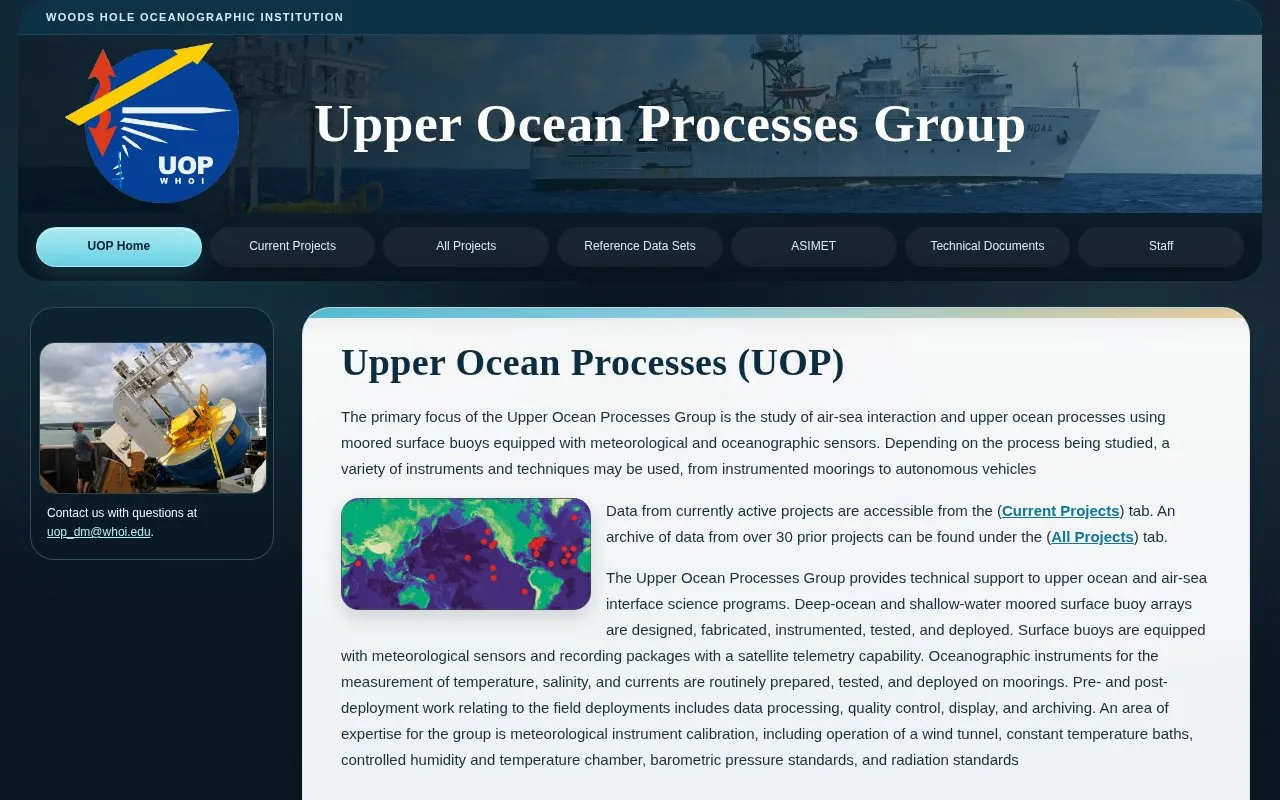
About Upper Ocean Processes Group
The Upper Ocean Processes Group at the Woods Hole Oceanographic Institution studies air-sea interaction and upper ocean processes. Its main method is moored surface buoys fitted with meteorological and oceanographic sensors, which can be combined with other instruments such as autonomous vehicles depending on the study. The group designs, builds, instruments, tests and deploys deep-ocean and shallow-water buoy arrays, and it calibrates meteorological instruments in its own facilities.
The website provides access to data from current projects and an archive from more than 30 earlier projects. Ocean Reference Stations supply long time series of quality-controlled oceanographic and marine meteorological data, with near real-time and delayed-mode processed data available from the site. Surface meteorological data from these stations is not placed on the GTS network and is not available for atmospheric model initialization, so it is used as independent data for model validation. Funding, principal investigators and affiliations vary by dataset and are recorded in the NetCDF file metadata.
Key features
- Archive of data from over 30 prior projects
- Current project data accessible through a dedicated tab
- Near real-time telemetered buoy data and delayed-mode processed data
- Long-term time series from Ocean Reference Stations, with calibrated sensors and quality control
- Merged Reference Data Sets for air-sea heat, freshwater and momentum flux computation
- Dataset-specific funding and project information embedded in NetCDF metadata
- Data is made freely available to the public and science community as soon as possible, in standardized, documented formats.
- Ocean Reference Stations data is managed under the OceanSITES project and F.A.I.R. data standards.
- Surface meteorological data from the Ocean Reference Stations is independent of model initialization, which makes it useful for model validation.
- Surface meteorological data from the Ocean Reference Stations is not available for atmospheric model initialization.
- Funding sources, principal investigators and affiliated organizations vary by project and must be checked in each file's metadata.
Upper Ocean Processes Group at a glance
- Website
- uop.whoi.edu
- Category
- Research & Data › Geographic & Mapping Data
- Type
- Website
- Pricing
- Not confirmed. Check the site
- Platforms
- Web
- Open source
- Not stated
- Last checked
- Oct 6, 2026 · Online when checked
- Listed
- Oct 5, 2026
Popular in Geographic & Mapping Data
Well-known listings from the same topic.



Upper Ocean Processes Group FAQ
Where can I find data from current projects?
How should I acknowledge UOP data in publications?
Can Ocean Reference Station meteorological data be used to initialize atmospheric models?
Tell us and an editor will check it.
Claim the listing and suggest updates yourself. An editor checks every claim first.