NOAA’s Barrow Observatory conducts research on greenhouse gases, aerosols, surface radiation and stratospheric ozone.
DSMZ
The Leibniz Institute DSMZ provides microorganisms and cell cultures for research and industry, with research spanning microbial and cell biodiversity.
About DSMZ
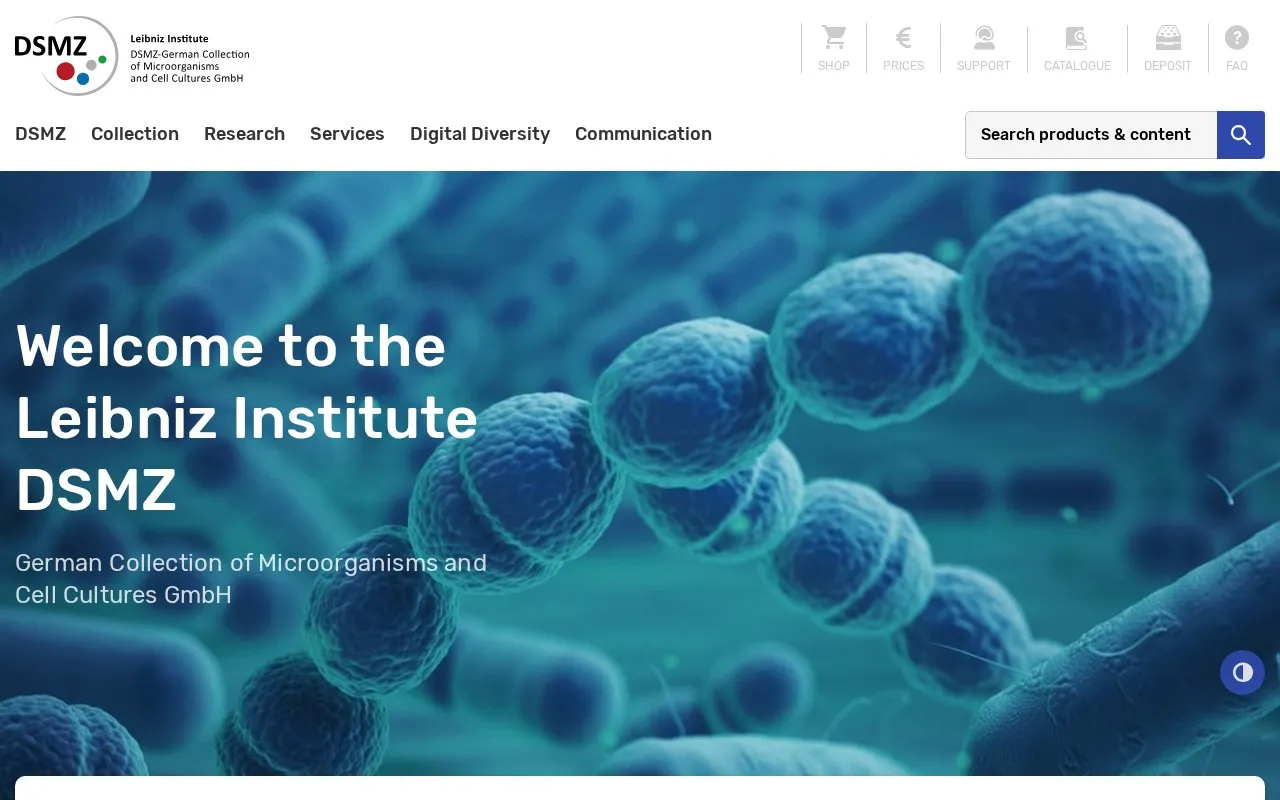
The Leibniz Institute DSMZ is the German Collection of Microorganisms and Cell Cultures. Its website presents the institute's catalogue of biological materials, including bacteria, archaea, fungi and yeasts, plant viruses, bacteriophages, plasmids, and human and animal cell lines. It also lists laboratory services such as identification, characterization, specific analyses and diagnostics, and it offers an online shop for researchers in academia and industry. The homepage states that about 100 scientists at the institute work on biodiversity in prokaryotes and eukaryotes.
The homepage describes bioresources and laboratory services. It does not describe climate or environmental datasets, so visitors looking for environmental data should check whether the material matches their needs.
Key features
- Online shop catalogue of microorganisms, cell cultures and other bioresources
- Strain collections listed by group, including over 41,500 bacterial strains
- TYGS genome-based classification and identification of prokaryotic strains
- LPSN compilation of validly published names of Bacteria and Archaea
- STR profiling for authentication of human cell line samples
- Mycoplasma detection and elimination, and plant virus detection and diagnostics
Best for: Researchers in microbiology, virology and cell biology, in academic or industry settings, who need biological materials or laboratory identification and authentication services.
Good for
- Lists large collections, including over 41,500 bacterial strains and over 1,000 plant viruses
- Provides a metadatabase of organism-linked information on bacterial and archaeal biodiversity
DSMZ at a glance
- Website
- dsmz.de
- Category
- Research & Data › Climate & Environmental Data
- Type
- Website
- Pricing
- Not confirmed. Check the site
- Platforms
- Web
- Open source
- Not stated
- Language
- English
- Last checked
- Oct 6, 2026 · Online when checked
- Listed
- Oct 5, 2026
DSMZ alternatives
Tools and sites you could use instead, ranked by how closely they match.

AidData researches development investments with granular data to help assess who funds what, where and with what effects.

CUAHSI supports water science through education and data services, representing universities and developing research infrastructure.

The Met Office page introduces research on weather and climate prediction by its Chief Scientist.
The EDGAR emissions database covers anthropogenic greenhouse gases and air pollution around the world, drawing on multiple sources.

AgTrials collects agricultural field-experiment data to study adaptation to climate change across farming contexts.
Popular in Climate & Environmental Data
Well-known listings from the same topic.
IOOS®ioos.noaa.govClouds and the Earth's Radiant Energy Systemceres.larc.nasa.govOCTOPUS databaseoctopusdata.orgVectorSurvvectorsurv.orgPAINTpaint-database.orgSIBiLSsibils.org


DSMZ FAQ
What types of biological material are listed on the site?
The homepage lists bacteria, archaea, plant viruses, human and animal cell lines, plasmids, fungi and yeasts, bacteriophages, and cyanobacteria and protists.
How can human cell lines be authenticated?
The site states that STR profiling is used for authentication of human cell line samples, because STR microsatellites are stable and highly polymorphic in human populations.
Is something wrong or out of date?
Tell us and an editor will check it.
Own this website?
Claim this listing
Claim the listing and suggest updates yourself. An editor checks every claim first.