
Follow this evolving guide for steps and configuration examples to secure a Linux server.
Linux Hardening
Follow this Linux hardening guide for steps to improve the security of a Linux system.
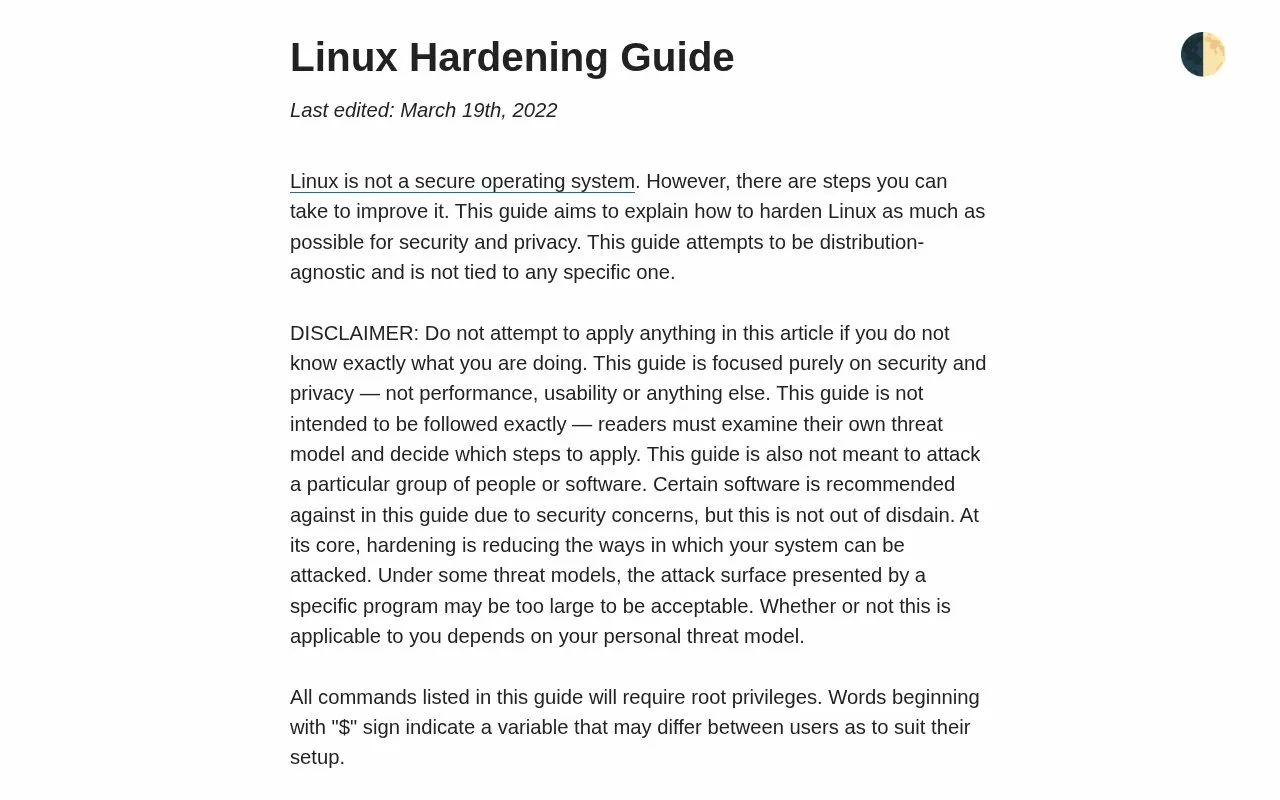
About Linux Hardening
This site provides a Linux hardening guide aimed at improving security and privacy. It covers topics such as kernel settings, mandatory access control, sandboxing, firewalls, file permissions, identifiers, and physical security, and aims to be distribution-agnostic.
All listed commands require root privileges. The guide states it is focused only on security and privacy, not performance or usability, and is not meant to be followed exactly; readers are expected to review their own threat model and decide which steps to apply.
Key features
- Explains kernel hardening via sysctl and boot parameters
- Covers application and systemd service sandboxing methods
- Documents mandatory access control and memory allocator hardening
- Addresses identifiers like hostnames, MAC addresses, time settings
- Covers physical security including encryption and bootloader passwords
- Explains file permissions, core dumps, firewall and root account hardening
Best for: People with advanced Linux knowledge who can assess security trade-offs for their own system.
Good for
- Aims to be distribution-agnostic rather than tied to one distribution
- Covers multiple areas including kernel, sandboxing, network identifiers and physical security
- Advises readers to consider their threat model before applying steps
Watch out for
- All commands require root privileges
- Focused purely on security and privacy, not performance or usability
- States readers should not apply steps without knowing exactly what they are doing
Linux Hardening at a glance
- Category
- Privacy & Security › Desktop & OS Privacy
- Type
- Website
- Pricing
- Not confirmed. Check the site
- Platforms
- Linux, Web
- Open source
- Not stated
- Language
- English
- Last checked
- Oct 5, 2026 · Online when checked
- Listed
- Oct 5, 2026
Linux Hardening alternatives
Tools and sites you could use instead, ranked by how closely they match.

Qubes OS is a free, open-source operating system for personal computers that uses compartmentalization as a security approach.
This guide collects Linux kernel and userland settings for improving security and usability, targeting Arch Linux and potentially other distributions.

OnionHop routes desktop traffic through Tor, with proxy and system-wide VPN modes, bridges, split tunneling, and a kill switch.

Tracee monitors runtime security events and supports forensic analysis with eBPF instrumentation.

The ArchWiki guide covers securely wiping a disk, with related security articles and Arch Linux resources on the wiki.
Popular in Desktop & OS Privacy
Well-known listings from the same topic.
wBlockapps.apple.com/app/wblock/id6746388723uBO Lite Safariapps.apple.com/app/ublock-origin-lite/id674534…Stayapps.apple.com/app/stay-for-safari/id1591620171Lockdown Privacylockdownprivacy.comTor Browsertorproject.orgFirejailfirejail.wordpress.com


Is something wrong or out of date?
Tell us and an editor will check it.
Own this website?
Claim this listing
Claim the listing and suggest updates yourself. An editor checks every claim first.