

Route DNS queries through Quad9, a free public recursive resolver focused on security and privacy.
Unbound
Run Unbound as a validating, recursive, caching DNS resolver for network domain lookups.
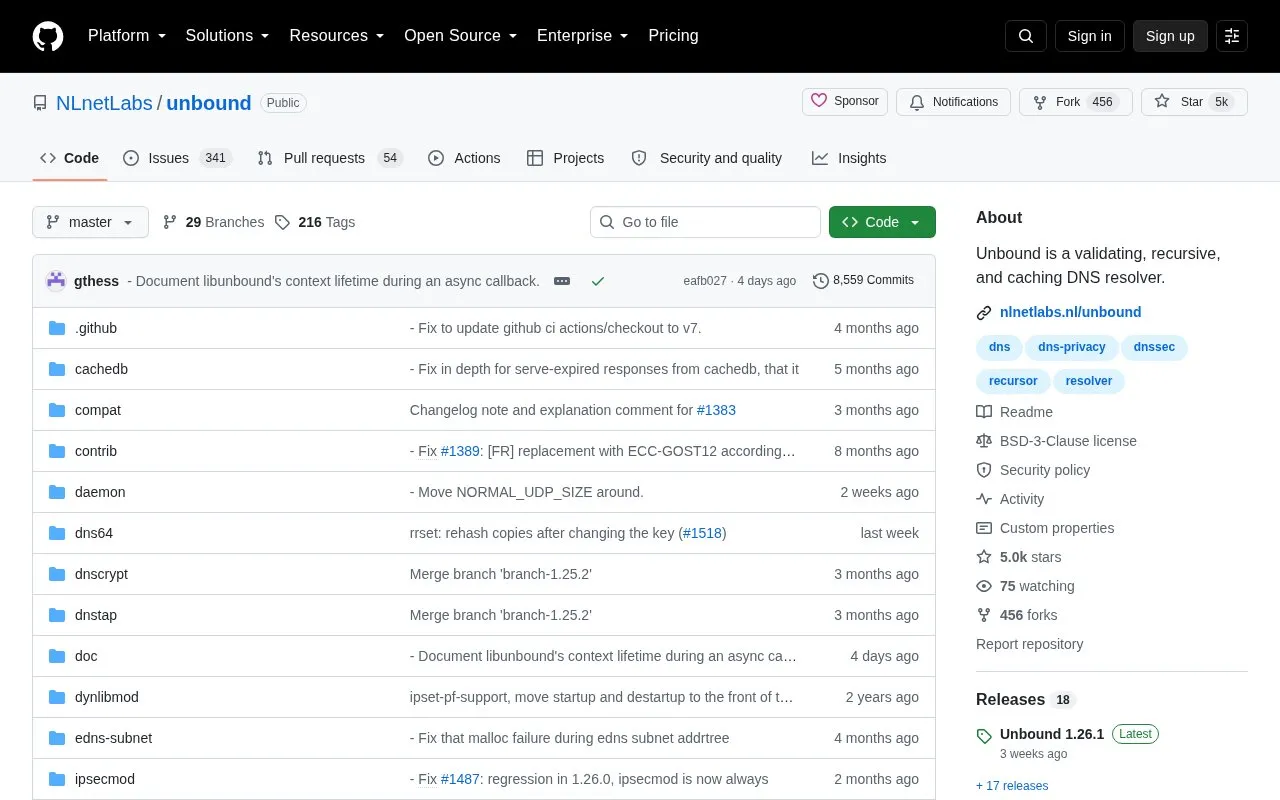
About Unbound
Unbound is a validating, recursive, caching DNS resolver for domain lookups. It is configured through unbound.conf options, with an example file in doc/example.conf.
It builds from source with ./configure && make && make install. Building requires a C toolchain, OpenSSL with include files, and libexpat, plus flex and bison when building from repository source.
Key features
- Performs validating, recursive DNS resolution
- Caches DNS lookup results
- Configures through unbound.conf file options
- Supports optional libevent for many outgoing ports
- Uses built-in handling for up to 256 ports by default
Best for: People who need to build and run their own validating, recursive, caching DNS resolver.
Good for
- Open source under BSD-3-Clause license
- Based on open standards
- Includes example configuration and man page reference
Watch out for
- Requires C toolchain, OpenSSL, and libexpat to compile
- Repository builds also require flex and bison
- Default build opens max 256 ports at once without libevent
Unbound at a glance
- Website
- github.com/NLnetLabs/unbound
- Category
- Development › Network Tools
- Type
- Open-source project
- Pricing
- Not confirmed. Check the site
- Open source
- Yes · Source code
- Language
- English
- Last checked
- Oct 6, 2026 · Online when checked
- Listed
- Oct 5, 2026
Unbound alternatives
Tools and sites you could use instead, ranked by how closely they match.

Explore HaGeZi DNS free, non-commercial public DNS servers operated in Europe.
Open source
24 alternatives
Run nsupdate.info as a free dynamic DNS service or use its software to host your own service.
FreeOpen source
24 alternatives
Compare self-hosted alternatives to ngrok, Cloudflare Tunnel, Tailscale, and ZeroTier in this tunneling tools list.
Meshtastic is open-source mesh networking software for low-power devices used off-grid.

Resolve and cache DNS queries with Unbound, a validating resolver that supports encrypted DNS protocols.
Popular in Network Tools
Well-known listings from the same topic.
Cloudflare Speed Testspeed.cloudflare.comWiFi Analyzerapps.microsoft.com/store/detail/wifi-analyzer/…Check-Hostcheck-host.netis-a.devis-a.devHurricane Electricdns.he.netWiresharkwireshark.org


Unbound FAQ
How do I compile and install Unbound?
Install the C toolchain, OpenSSL with include files, and libexpat, plus flex and bison for repository source, then run ./configure && make && make install.
How do I configure Unbound?
Use the options described in the unbound.conf(5) man page; an example file is in doc/example.conf.
When should I use libevent?
It is optional and useful with many outgoing ports, such as 10000, using --with-libevent; without it, the default handles max 256 ports at the same time.
Is something wrong or out of date?
Tell us and an editor will check it.
Own this website?
Claim this listing
Claim the listing and suggest updates yourself. An editor checks every claim first.