
LiveStreamDVR
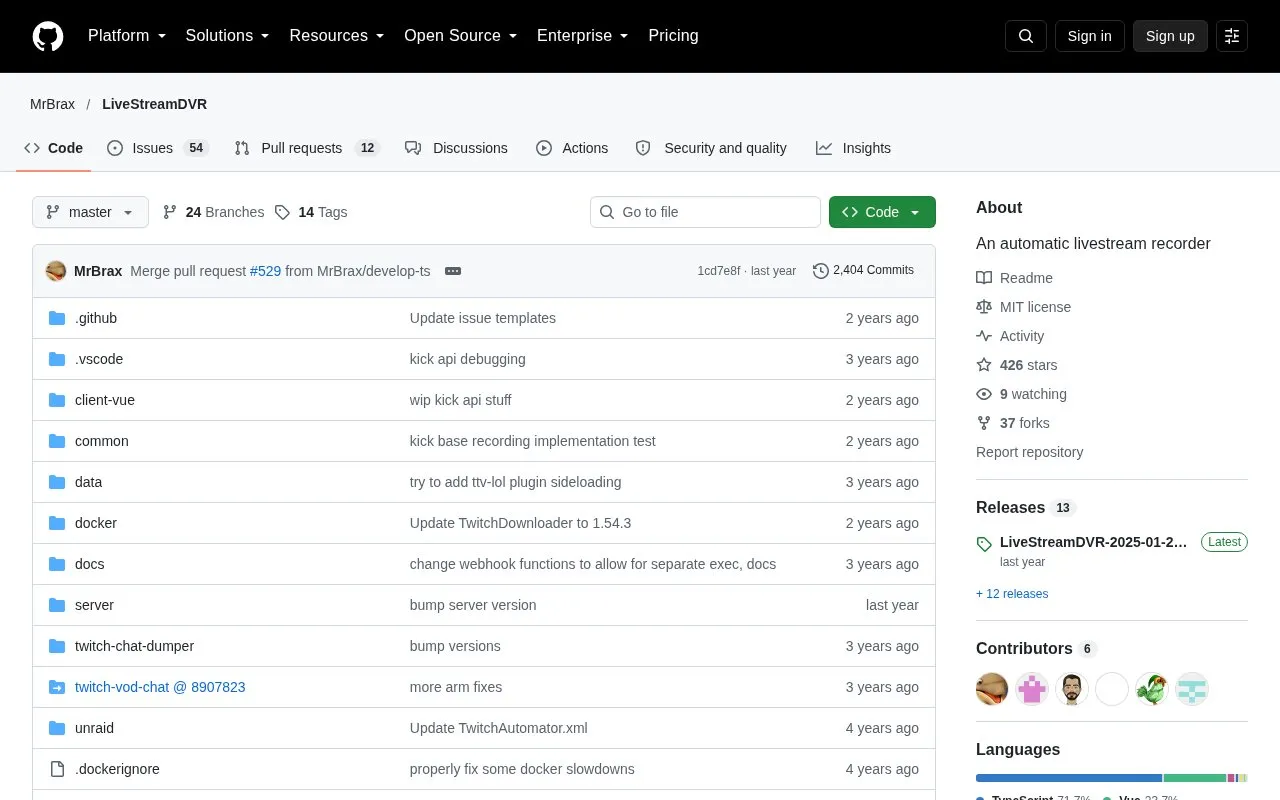
LiveStreamDVR automatically records livestreams, according to its repository description.
About LiveStreamDVR
LiveStreamDVR is an open source tool that automatically records livestreams. Rather than checking for live channels every minute, it starts capturing around when a stream goes live, usually about two minutes after, because of notification delays. Recordings can be stored with metadata such as game played, stream title, duration, and whether music was muted, and chapters are written into the final video file. It can also be set to delete the oldest recordings for each streamer once a storage limit is reached.
The application has setup requirements. Until Twitch changes its websocket EventSub quota, it needs a public-facing HTTPS server to function, and a reverse proxy is suggested for this. The source notes that this has only been tested with Nginx and Let's Encrypt. It can run through Docker or as a standalone install, which requires Node.js 20+, Python 3.9+, FFmpeg, MediaInfo, and streamlink. The author states they do not use Docker for their own capturing, so Docker-specific errors are hard to test. Storage use is substantial: the source gives an example of about 30 to 50 GB for a 10-hour VOD at 1080p60 from a high-profile streamer.
Key features
- Automatic VOD recording around when a stream goes live
- Cyclic recording that deletes the oldest streams when a per-streamer storage limit is reached
- Chapters with titles and games written to the final video file
- Built-in video player with chat playback and a video cutter
- Viewer count logging with graphs
- Notifications through browser, Telegram, Pushover, and Discord
Best for: Technically comfortable users who want to self-host automatic archiving of livestreams and have sufficient storage and a public HTTPS server.
Good for
- Writes recordings as TS files so a crash is less likely to corrupt the file
- Can write a LosslessCut-compatible CSV for the full VOD
- Can export videos to external files, SFTP, and YouTube
Watch out for
- Requires a public-facing HTTPS server to function until Twitch changes its EventSub quota
- Storage use is high, with about 30 to 50 GB for a 10-hour 1080p60 VOD from a high-profile streamer
- The author does not use Docker for capturing, so Docker-specific issues are hard to test
LiveStreamDVR at a glance
- Type
- Open-source project
- Pricing
- Not confirmed. Check the site
- Open source
- Yes · Source code
- Language
- English
- Last checked
- Oct 6, 2026 · Online when checked
- Listed
- Oct 5, 2026
Guides for Screen Recording & Streaming Tools
LiveStreamDVR alternatives
Tools and sites you could use instead, ranked by how closely they match.

Moblin provides an iOS app for livestreaming in real life, according to its repository description.
FreeOpen source
24 alternatives
RePlays automatically records detected games and includes a clip editor for quickly sharing video highlights.
Open source
24 alternatives
Chat Downloader retrieves chat messages from livestreams, videos, clips, and past broadcasts without authentication, with Python installation options.
Open source
24 alternatives
This Windows screen annotation project is a fork of gInk, according to its repository description.
Open source
24 alternatives
LiveDraw lets users draw or mark over the screen in real time while presenting dynamic content, according to its repository description.
Open source
24 alternatives
Segra records gameplay through OBS and can automatically clip highlights across supported games; its page describes it as free and open source.
Open source
24 alternativesPopular in Screen Recording & Streaming Tools
Well-known listings from the same topic.
StreamElementsstreamelements.comStreamlabsstreamlabs.comStreamer.botstreamer.botAwesome Streaminggithub.com/juancarlospaco/awesome-streaming-to…VDO.Ninjavdo.ninjaStreamrecorderstreamrecorder.io


LiveStreamDVR FAQ
Does LiveStreamDVR need a public server?
Until Twitch changes the maximum quota on websocket EventSubs, a public-facing HTTPS server is required for the application to function. A reverse proxy is suggested as a way to meet this requirement.
How much storage does a recording use?
The source gives an example of about 30 to 50 GB for a 10-hour VOD at 1080p60 from a high-profile streamer. Cyclic recording can delete the oldest streams once a set storage limit per streamer is reached.
Can it save chat along with the video?
Yes, optionally. It can dump chat while capturing or download the chat file after the stream ends, and it can save the whole stream chat to a JSON file.
Is something wrong or out of date?
Tell us and an editor will check it.
Own this website?
Claim this listing
Claim the listing and suggest updates yourself. An editor checks every claim first.