

NobodyWho runs language models locally through an inference engine designed for efficient operation across devices.
Open source
22 alternativesOpenLLM runs open-source language models as cloud API endpoints compatible with OpenAI clients.
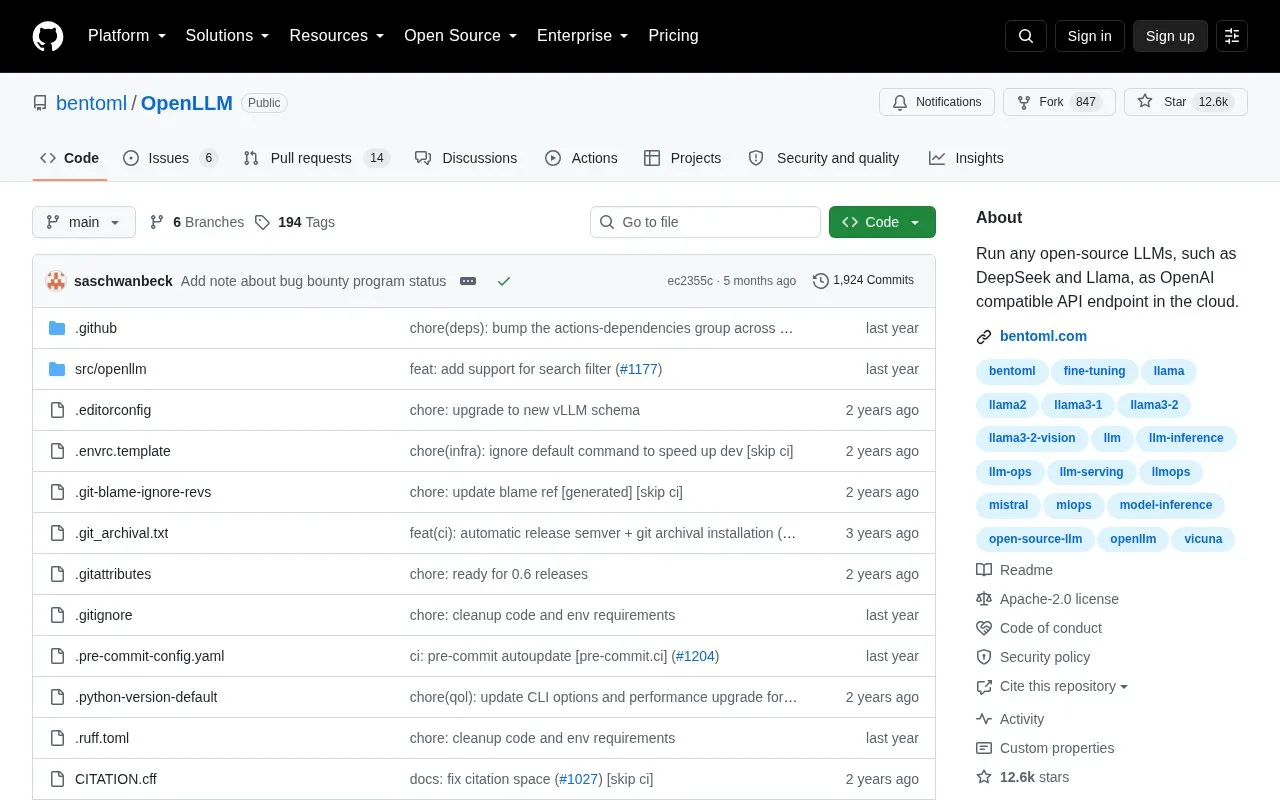
OpenLLM is an open-source tool from BentoML for running open-source language models as OpenAI-compatible API endpoints. After installing it with pip, a server is started with a single command such as "openllm serve llama3.2:1b"; by default the API is available at http://localhost:3000 and can be called by clients and frameworks that support OpenAI-compatible APIs, including the OpenAI Python client and LlamaIndex. It also provides a chat UI at the /chat endpoint and CLI chat through "openllm run".
Supported models listed by the project include DeepSeek R1, Gemma, Jamba, Llama 3.1 through Llama 4, Mistral, Phi, Pixtral, Qwen2.5 and QwQ, and a model repository can be added to run custom models. GPU requirements differ per model, ranging from roughly 12G for small models to 80G x 16 for DeepSeek r1-671b. OpenLLM does not store model weights, and a Hugging Face token is required for gated models. Deployment workflows are described for Docker, Kubernetes and BentoCloud. Pricing information is not stated.
Tools and sites you could use instead, ranked by how closely they match.
NobodyWho runs language models locally through an inference engine designed for efficient operation across devices.
GPUStack manages GPU clusters for serving AI models and provides on demand GPU instances accessible through SSH.
For Apple Silicon, Rapid-MLX offers an open-source LLM inference server and Mac app compatible with OpenAI and Anthropic APIs.
LLMKube runs self hosted LLM inference across heterogeneous GPU fleets using Kubernetes and several model runtimes.
PowerInfer supports serving large language models for local deployment and inference.
bitsandbytes enables large language models in PyTorch using k-bit quantization.
Well-known listings from the same topic.
Tell us and an editor will check it.
Claim the listing and suggest updates yourself. An editor checks every claim first.


